"What's an asymptomatic remodel, wot?" exclaimed Watley, looking over my shoulder as I penned the latest entry in my casebook.
"Watley, my good friend," I exclaimed, "you are most certainly a doctor. I reach this deduction, you see, based on your mis-reading of the entry in my casebook. Were you a mathematician, you would have read it properly, as 'asymptotic', referring to a mathematical formula in which a value approaches a limit over time but never reaches it, which is also, incidentally, the word that is written there. But not being a mathematician, as I have just established, you must perforce be a doctor. That is known, to logicians, as the law of the excluded middle, since at the moment I can't recall any other professions. Other than private detective, the most esteemed of all professions, which you most certainly are not, or you would have long ago deduced yourself that you are a doctor. Ah ha ha."
Perhaps I should not have chortled in so derisive a manner, but occasionally my joyful indulgence in my own deductive genius manifests as a somewhat dismissive derisiveness toward others' intellectual inferiority.
"Yes, well," replied he. "You are deucedly good at deducing that I am a doctor. Happens with great frequency. No doubt it helps that you already know that I am a doctor."
I informed Watley that, as I am unable to recall from day to day that he is a doctor, my feats of deduction are worthy of a great deal more respect, as they prove me a genius.
"Nevermind all that," he replied in his idiotically good-natured way, "but what of this asymptotic rot and all?"
"Perhaps you have noticed," I informed him, jabbing the bit of my pipe at his chest, "that there is no furniture in the room. That is why I am standing here writing in my casebook without benefit of chair or table."
"That would not explain how I could be looking over your shoulder," responded Watley, who I had once again forgotten was shorter than me. Had he grown overnight? Recalling that once all other possibilities had been eliminated, the only remaining possibility, no matter how unlikely, must be the case, I concluded that he had, in fact, grown overnight. Remarkable. I was about to remark on this, when I happened to sagely nod my head in a downward direction, and noted with astonishment that Watley was standing on a small footstool, which extended one of his many bodily dimensions by several inches, possibly too many to count.
"Hmph, yes, well, aside from the footstool." With this supplementary statement I once again took the high ground. That is to say, I kicked the footstool out from under Watley's feet. Looking now at Watley, a though occurred to me. Had Watley shrunk since this morning?
"It's those dastardly plasterers, masoners, carpenters, hodders, bricksters, and moulderers!" I sputtered. "What is preventing them from completing repairs so that we can set things aright in here? The closer they get to completion, the less they are finishing. It's a puzzle, indeed."
I took a puff of my pipe, scrawled "SOLVED" in a profoundly intellectual hand across the page, and closed the casebook with a triumphant clap. A glance at Watley established that he had, inexplicably, not changed height.
Sunday, January 30, 2011


Tuesday, September 14, 2010
The Case of the Shrinking Summer
"Watley! It's still June, is it not?" I stared dumbly at the calendar, which stubbornly read "September".
"I still have three more months until teaching duties at Investigator University begin, right?" I stared dumbly at the calendar, which stubbornly read "September".
"No harm would come from just correcting this calendar to June, I dare say, eh?" I tugged in vain at the page of the calendar, at which I stared dumbly.
Sigh.
"I still have three more months until teaching duties at Investigator University begin, right?" I stared dumbly at the calendar, which stubbornly read "September".
"No harm would come from just correcting this calendar to June, I dare say, eh?" I tugged in vain at the page of the calendar, at which I stared dumbly.
Sigh.
Sunday, July 04, 2010
The Case of the Vanishing Obese People
The Empire of Nippon seems remarkably devoid of the shockingly obese. Indeed, merely stout fellows are hard to come by. Such a contrast to my own Emerald Isle, which is hardly lacking in porkers.
Where have all the overfed disappeared to? I pondered this question while pacing the streets, searching for my vanished umbrella. Suddenly I found myself facing a dead end. Looking up, I was startled to see an enormous poster:
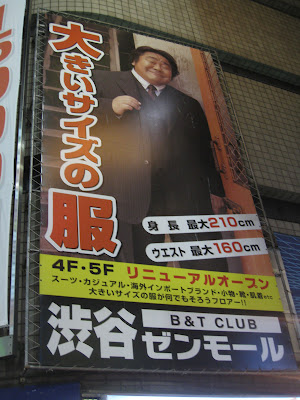 Ah-ha! The solution to the conundrum was quite literally staring me in the face. No doubt all of the Nipponese fatties are at this very moment crowded into this haberdashery, purchasing oversized suits. That neatly explains their absence from the city streets.
Where have all the overfed disappeared to? I pondered this question while pacing the streets, searching for my vanished umbrella. Suddenly I found myself facing a dead end. Looking up, I was startled to see an enormous poster:
 Ah-ha! The solution to the conundrum was quite literally staring me in the face. No doubt all of the Nipponese fatties are at this very moment crowded into this haberdashery, purchasing oversized suits. That neatly explains their absence from the city streets.
Tuesday, June 15, 2010
The Case of the Stolen Umbrella
A most harrowing incident, which because of the complexity of incidental details will have to await elucidation at a further time, required my personal presence in the Empire of Nippon. Watley declined to journey with me, explaining that he would be busy eating breakfast for the next year or so, and so I set off on my own for the remote island of Quarterborough. After a sea voyage of some length, I at last arrived, older and more brilliant by several months.
As it was the Plum Season, marked by heavy rains, the ryoukan where I was lodged most hospitably provided me with an umbrella, whose handle was marked with mysterious glyphs 職員会館.
I set out in the morning for my scheduled appointment with my client amidst a caninical-felinical downpour, grateful for the use of this Oriental parapluie. Arriving at the building where my meeting was to take place, I saw several umbrellas carefully set just inside the doorway. Inducing that the Nipponese were most attentive to maintaining a comfortable interior space, I concluded that wet umbrellas should not be carried beyond the threshold, lest they sully the interior with moisture. After some moments of deduction, followed by a lengthy period of induction, and at last postceded by a fleeting instant of reduction (for good measure), I decided to place my own umbrella beside the others. As I did so I congratulated myself on my cultural sensitivity and general sharpness of intellect.
However, when I emerged from my meeting several hours later, my umbrella was nowhere to be found. But then I asked myself: how do I know it is my umbrella that is nowhere to be found, and not some other poor fellow's umbrella that is nowhere to be found, and that this fine umbrella right here is not mine? Unable to resolve this conundrum, I concluded that I must take that umbrella, which might as well be mine for all I knew, and carry it off with me. Sadly, just as I was about to triumphantly carry out this scheme, my extraordinarily competent mind revealed a key memory, which perhaps you, dear reader, will understand better if you cast your eye back to the very near-beginning of this tale. You will, I'm sure, be shocked to be reminded that my umbrella was carefully marked with several mysterious glyphs, to wit: 職員会館. I however, knowing the great power of my own faculty of recall, was not shocked, merely disappointed, for logically I was forced to conclude that it was indeed my own umbrella that was nowhere to be found. Not wishing to run afoul of the Oriental police, I set the umbrella in my hands back down, and stepped into the heavy rain with only my deerstalker to protect me.
Sunday, March 07, 2010
The Case of the Rejected Patent
Watley knocked on my door bearing an intriguing letter in the morning's post.
"From America!", he exclaimed, beaming with excitement.
"Any fool could see that," I snapped. "Especially me," I added, to make it clear that the United Statesal origin of the epistle had not escaped my keen detective's eye.
I settled into my settling chair, lit a pipe, filled a bowl with filberts, and sliced open the envelope with my Official Detectivator Open Letterer. Watley eagerly though somewhat awkwardly, stood pinned in the narrow space between the shoulder of the chair and the corner of the room, peering over my shoulder. I blew forcefully to fluff open the envelope, then carefully extracted its contents. A single sheet of paper, folded in thirds.
"My dear Sleuthe," the letter opened. It continued:
"Well, Watley," I declared, "The man is clearly insane. I believe this is the first time I will reject a case. And with rent due, at that."
I paused, then added: "I call it: The Case of the Rejected Patent!"
"From America!", he exclaimed, beaming with excitement.
"Any fool could see that," I snapped. "Especially me," I added, to make it clear that the United Statesal origin of the epistle had not escaped my keen detective's eye.
I settled into my settling chair, lit a pipe, filled a bowl with filberts, and sliced open the envelope with my Official Detectivator Open Letterer. Watley eagerly though somewhat awkwardly, stood pinned in the narrow space between the shoulder of the chair and the corner of the room, peering over my shoulder. I blew forcefully to fluff open the envelope, then carefully extracted its contents. A single sheet of paper, folded in thirds.
"My dear Sleuthe," the letter opened. It continued:
Your fame has spread even to these shores. Only your intellect and insight can save me from a grave injustice!
I recently submitted the following patent request to the government of the United States of America. It was rejected! Rejected, I say!Application for one "object-avoidance echo-location device".Rejected, I say! I wish to engage your services to investigate this gross miscarriage of justice. I am prepared to provide significant monetary recompense.Items: human (one); bat, trained (one)
Mechanism: Place bat on left (or right) shoulder of human. Instruct human to emit high-pitched squeak. Bat will then use echo-location skills to instruct human appropriately, viz. "Watch out! Go left! Left! Even farther left than I think!" (Note: if bat is on right shoulder, the last sentence should read "But not as far left as I think!".)
Note 1: Bat training protocol must include English-language speaking instruction.
Note 2: Human should keep eyes closed at all times. Else, what's the point?
Note 3: Amendment to note 1. In other countries, non-English-speaking bats may be employed.
"Well, Watley," I declared, "The man is clearly insane. I believe this is the first time I will reject a case. And with rent due, at that."
I paused, then added: "I call it: The Case of the Rejected Patent!"
Sunday, February 14, 2010
The Case of the Postal Discount
Just the other fortnight I had occasion to send an urgent document to a client sojourning in the Empire of Nippon, located far to the east. Watley informed me that, following the recent establishment of the Universal Postal Union by the Royal Prussian Minister for Posts, Heinrich von Stephan (whom Watley assured me was a most unpleasant man, a fact I had already deduced mere moments after he so informed me), Her Majesty's Royal Mail had but just inaugurated an express delivery service to the far corners of the globe.
I thereupon signed my name to the document, powdered and blotted it, folded and sealed it, and sent it round with Watley to the post, with careful instructions regarding the grades of marmalade and filberts he was to purchase at the jammers' and nutters' on his return. Watley merrily set off, shaking his head and muttering something indistinct under his breath about "a real nutter", whatever that might mean, and I thought no more about him.
Strictly speaking, that last phrase is not correct, since upon Watley's return, as he stood before me and spoke to me, I found my thoughts once more turning to him.
"A most peculiar thing, my dear fellow," he exclaimed. "I was informed by the postal clark that there are two categories of service to Nippon, dubbed 'priority' and 'economy', from the names of which I deduced that the former constituted a speedier service and the latter a less expensive one."
"I'll do the deducing around here, Watley," I interjected.
"The fellow next informed me that the 'priority' service would cost 75 quid, and the document would arrive at its imperial destination in seven months."
"75 bob!" I gasped, first at the expense, then at the realization that I'd once again forgotten if 'bob' and 'quid' referred to the same unit of currency or not. To avoid any appearance of ignorance, I coughed loudly. "--kof-- 75 bob ... bob ... bobosterous, I say!"
"Precisely what I exclaimed, Sleuthe, though with an additional 'r'. Recalling that you still hadn't received your fee for solving the Case of the Bankrupt Client, and well aware that rent is coming due, I then inquired about the 'economy' service."
"Ah yes, the economy service, quite the thing." I spoke with some relief.
"But that's just the rub, there, you see," Watley continued. "The economy service was 92 quid. And the amount of time it would take to deliver was identical: seven months."
I gasped audibly, then silently. My mind was at a loss for words.
"Not to worry, old chap. I popped into the jammers, and for only 15 quid, they agreed to deliver the document. You see, they are now making regular voyages to Nippon. There is, apparently, a thriving trade in quince and gingko."
Watley and I celebrated his stroke of genius with a handful of filberts.
I thereupon signed my name to the document, powdered and blotted it, folded and sealed it, and sent it round with Watley to the post, with careful instructions regarding the grades of marmalade and filberts he was to purchase at the jammers' and nutters' on his return. Watley merrily set off, shaking his head and muttering something indistinct under his breath about "a real nutter", whatever that might mean, and I thought no more about him.
Strictly speaking, that last phrase is not correct, since upon Watley's return, as he stood before me and spoke to me, I found my thoughts once more turning to him.
"A most peculiar thing, my dear fellow," he exclaimed. "I was informed by the postal clark that there are two categories of service to Nippon, dubbed 'priority' and 'economy', from the names of which I deduced that the former constituted a speedier service and the latter a less expensive one."
"I'll do the deducing around here, Watley," I interjected.
"The fellow next informed me that the 'priority' service would cost 75 quid, and the document would arrive at its imperial destination in seven months."
"75 bob!" I gasped, first at the expense, then at the realization that I'd once again forgotten if 'bob' and 'quid' referred to the same unit of currency or not. To avoid any appearance of ignorance, I coughed loudly. "--kof-- 75 bob ... bob ... bobosterous, I say!"
"Precisely what I exclaimed, Sleuthe, though with an additional 'r'. Recalling that you still hadn't received your fee for solving the Case of the Bankrupt Client, and well aware that rent is coming due, I then inquired about the 'economy' service."
"Ah yes, the economy service, quite the thing." I spoke with some relief.
"But that's just the rub, there, you see," Watley continued. "The economy service was 92 quid. And the amount of time it would take to deliver was identical: seven months."
I gasped audibly, then silently. My mind was at a loss for words.
"Not to worry, old chap. I popped into the jammers, and for only 15 quid, they agreed to deliver the document. You see, they are now making regular voyages to Nippon. There is, apparently, a thriving trade in quince and gingko."
Watley and I celebrated his stroke of genius with a handful of filberts.
Sunday, November 29, 2009
The Case of the Lingering Cough
Watley and I were settled comfortably in the smoking room. I in my smoking jacket reclined elegantly in my smoking chair, while Watley in his smoking jacket perched somewhat less elegantly on his smoking chair.
"I -kof- say, Sleuthe," said Watley, speaking somewhat indistinctly around the stem of his pipe, "that was quite a nasty bit of the ol' grippe there, wot?" Watley punctuated his statement with a loud hacking noise.
"Indeed, indeed," I muttered as I lit the end of my cigar with my smoking match. "Nasty -kof- fever, unpleasant -kof- muscle pains, stuffed -kof- sinuses, painful -kof- throat. Then of course there's the cough."
"Indeed -hack-, the cough. How do you feel now, -kof- Sleuthe old boy?"
"Fine, just fine, fully recovered. Except of course for this -kof-kof- cough."
"It's been weeks. Wonder why the damned thing won't go away?" Watley tapped some ash into the smoking tray, sputtering.
"No idea, Watley ol' chap. It's a -kof- mystery indeed. Cigar?"
"Don't mind if I -hack- do."
Soon enough Watley and I each had a pipe, cigar, and a few cigarettes puffing along merrily.
"-kof-kof-kof-"
"-kof-kof-kof-"
"I -kof- say, Sleuthe," said Watley, speaking somewhat indistinctly around the stem of his pipe, "that was quite a nasty bit of the ol' grippe there, wot?" Watley punctuated his statement with a loud hacking noise.
"Indeed, indeed," I muttered as I lit the end of my cigar with my smoking match. "Nasty -kof- fever, unpleasant -kof- muscle pains, stuffed -kof- sinuses, painful -kof- throat. Then of course there's the cough."
"Indeed -hack-, the cough. How do you feel now, -kof- Sleuthe old boy?"
"Fine, just fine, fully recovered. Except of course for this -kof-kof- cough."
"It's been weeks. Wonder why the damned thing won't go away?" Watley tapped some ash into the smoking tray, sputtering.
"No idea, Watley ol' chap. It's a -kof- mystery indeed. Cigar?"
"Don't mind if I -hack- do."
Soon enough Watley and I each had a pipe, cigar, and a few cigarettes puffing along merrily.
"-kof-kof-kof-"
"-kof-kof-kof-"
Sunday, November 22, 2009
The Case of the Unauthorized Casebook (cont'd)
Here the book ended. I slowly became aware of my slovenly state. How many hours had I been absorbed in these tales of derring-do and derring-don't? The stubble on my cheeks felt several days old to the touch of my fingers. I looked down and observed a distressing mixture of drool and filbert dust caking the collar of my dressing gown. My anger at Watley for painting me the fool in these tales was compounded by my anger at Watley for not writing more, and my anger for not informing me about this sure-fire money-making venture. I hastily calculated the royalties that Watley would be earning if he sold a dozen or fewer copies of the book. Then I doubled it. Then I tripled it. Then I wondered what the word was for fourtupling. Probably not 'fourtuple'. Oh, if only Watley were here, we could share an amused laugh at his ignorance of the correct word for 'fourtuple'. After which he would tell me the correct word.
There was nothing for it but to re-read the entire book. First, however, I would quiet that annoying closet door. I strode across the room, pulled open the door, and confronted the most unexpected sight that had ever befallen my eyes. "Why, hello, Watley old chap," I said, feigning the opposite of surprise. "I was just ... erm ... looking for some jam."
After several minutes of actually looking for some jam in the closet, I untied Watley and removed the gag from his mouth.
"I knew you'd come to my rescue," cried Watley, his voice cracking with what others might have mistaken for a burning thirst but I knew to be admiration.
Some time later, after we'd both had a spot of tea and a pipe, I confronted Watley about the casebook and its wild inaccuracies. "Why," I said, nearly chuckling at the ludicrousness of it, "to read this you'd think I was the buffoon and you the idiot, rather than the other way 'round!" I paused, feeling that I might have misspoken. "That is to say, you'd think I was the idiot and you the buffoon." I'd been called 'buffoon' often enough to have induced that it must denote a man of intelligence, good breeding, and hair, and I wasn't about to let Watley forget it.
"But Sleuthe," Watley protested. "Surely I needn't tell you what really happened, as no doubt you've already deduced it."
"Certainly," I replied, "but perhaps you'd best refresh your memory." I congratulated myself on this clever strategem for finding out what really happened. That's the kind of ploy they don't teach in detecting school, or wouldn't, if such a school existed, which it might for all I knew.
"Most kind of you, Sleuthe," mumbled Watley. "As you know, I was just about to knock on your door with a jar of filberts in one hand and a crock of jam in the other, when I realized that I'd have to put at least one of them down in order to successfully accomplish the knocking. At that point I went back up to my flat and put both down on the table, then returned to your door. As I was about to knock, I realized that I'd forgotten both the filberts and the jam."
"Naturally ..." I interjected, to let Watley know that I wished to give the impression that I already knew what he was going to say.
"Precisely, precisely. Naturally, I returned to my flat to collect the items. The moment I stepped inside the door, however, a ruffian attacked me. An editor, by the looks of him. 'I know ye,' he says, 'ye're thet frien' o' th' detector, th' one what solves awl them cases,' he continues to says."
"Sounds just like an editor," I commented, praising Watley's vocalizations.
"I remained silent, fearing for your safety. Then he tied me up, stuffed a gag in my mouth, and threw me in the closet. 'Now,' he says, 'yer'll tells me ev'rythin' what this detect've 'as done, and in all the best d'tail as wel', an 'if ye doon't, thar'll be troobl'.'
"I could tell this fellow meant business. 'Now st'rt t'lk'n,' he says, 'l'st all's wh't' l'ft 'r' 'postr'ph's.'"
"Good lord, Watley," I cried, "whatever did you do?" I paused, then realized my mistake. "I mean, What ever! Did ... you do!"
"Yes, precisely," said Watley, responding to my declarative tone of voice. "I had little choice, as you know. So I recited to him the facts of your most brilliant cases. And he wrote it all down. Only..."
"Yes, Watley?"
"He changed it all 'round, you see. He said it would sell better that way."
"Confounded editor!" I ventured a hypothesis: "So you dictated it all to him while bound and gagged?" Watley nodded. I went on: "And he wrote it all down, but changed it to make me look like less of a buffoon?" Watley paused, considered, then nodded again. I continued, my mind racing ahead of my mouth, intent on the solution. "He got your handwriting accurately, but not the content. And then ... and then ...." Here I paused, trembling at the inevitable conclusion. And yet, as is well known, once all—or some of—the logically possible outcomes have been eliminated, only the logically impossible outcome is left. "And then he left, carefully leaving the casebook behind."
"You've done it again, Sleuthe."
"Indeed I have. I call it ..." I paused for dramatic effect. "The Case of the Unauthorized Casebook!"
There was nothing for it but to re-read the entire book. First, however, I would quiet that annoying closet door. I strode across the room, pulled open the door, and confronted the most unexpected sight that had ever befallen my eyes. "Why, hello, Watley old chap," I said, feigning the opposite of surprise. "I was just ... erm ... looking for some jam."
After several minutes of actually looking for some jam in the closet, I untied Watley and removed the gag from his mouth.
"I knew you'd come to my rescue," cried Watley, his voice cracking with what others might have mistaken for a burning thirst but I knew to be admiration.
Some time later, after we'd both had a spot of tea and a pipe, I confronted Watley about the casebook and its wild inaccuracies. "Why," I said, nearly chuckling at the ludicrousness of it, "to read this you'd think I was the buffoon and you the idiot, rather than the other way 'round!" I paused, feeling that I might have misspoken. "That is to say, you'd think I was the idiot and you the buffoon." I'd been called 'buffoon' often enough to have induced that it must denote a man of intelligence, good breeding, and hair, and I wasn't about to let Watley forget it.
"But Sleuthe," Watley protested. "Surely I needn't tell you what really happened, as no doubt you've already deduced it."
"Certainly," I replied, "but perhaps you'd best refresh your memory." I congratulated myself on this clever strategem for finding out what really happened. That's the kind of ploy they don't teach in detecting school, or wouldn't, if such a school existed, which it might for all I knew.
"Most kind of you, Sleuthe," mumbled Watley. "As you know, I was just about to knock on your door with a jar of filberts in one hand and a crock of jam in the other, when I realized that I'd have to put at least one of them down in order to successfully accomplish the knocking. At that point I went back up to my flat and put both down on the table, then returned to your door. As I was about to knock, I realized that I'd forgotten both the filberts and the jam."
"Naturally ..." I interjected, to let Watley know that I wished to give the impression that I already knew what he was going to say.
"Precisely, precisely. Naturally, I returned to my flat to collect the items. The moment I stepped inside the door, however, a ruffian attacked me. An editor, by the looks of him. 'I know ye,' he says, 'ye're thet frien' o' th' detector, th' one what solves awl them cases,' he continues to says."
"Sounds just like an editor," I commented, praising Watley's vocalizations.
"I remained silent, fearing for your safety. Then he tied me up, stuffed a gag in my mouth, and threw me in the closet. 'Now,' he says, 'yer'll tells me ev'rythin' what this detect've 'as done, and in all the best d'tail as wel', an 'if ye doon't, thar'll be troobl'.'
"I could tell this fellow meant business. 'Now st'rt t'lk'n,' he says, 'l'st all's wh't' l'ft 'r' 'postr'ph's.'"
"Good lord, Watley," I cried, "whatever did you do?" I paused, then realized my mistake. "I mean, What ever! Did ... you do!"
"Yes, precisely," said Watley, responding to my declarative tone of voice. "I had little choice, as you know. So I recited to him the facts of your most brilliant cases. And he wrote it all down. Only..."
"Yes, Watley?"
"He changed it all 'round, you see. He said it would sell better that way."
"Confounded editor!" I ventured a hypothesis: "So you dictated it all to him while bound and gagged?" Watley nodded. I went on: "And he wrote it all down, but changed it to make me look like less of a buffoon?" Watley paused, considered, then nodded again. I continued, my mind racing ahead of my mouth, intent on the solution. "He got your handwriting accurately, but not the content. And then ... and then ...." Here I paused, trembling at the inevitable conclusion. And yet, as is well known, once all—or some of—the logically possible outcomes have been eliminated, only the logically impossible outcome is left. "And then he left, carefully leaving the casebook behind."
"You've done it again, Sleuthe."
"Indeed I have. I call it ..." I paused for dramatic effect. "The Case of the Unauthorized Casebook!"
Sunday, October 18, 2009
Case the Fourth: The Case of the Pseudo-Cleft Chin
More! more! I must read more! This dashing detectivator and his brilliant schemes thrilled me to the core. I would be no match for this fictional doppleganger, I mused as I turned the page. A good thing he and I weren't mortal enemies! I chuckled at the thought, then coughed up some errant filbert dust. As it settled onto the pages before me, my eyeballs followed its drift, and began to read.
"Good Lord, Sleuthe," moaned Watley as he somewhat dejectedly pulled on his dressing gown. "Was it really necessary to knock me up at the outrageous hour of ..." Watley patted down the pockets of his robe, but not finding his pocket watch in evidence, left the sentence suspended incomplete. He glanced outside, where the chill, ashen sky betrayed only the merest glimmerings of dawn. "... of, of, of before dawn?" he concluded, not without petulance. Watley was an amiable fellow, though, and after a moment's thought his face brightened considerably.
"I say, Sleuthe, are we out on an adventure this morning?" Now anticipating the unparalleled excitement of another excursion with myself, the world's greatest living detective (not to mention third-place winner of the most recent annual Welsh All-Round filbert-eating contest), Watley shook off the last vestiges of his somnolent state, and set about attending to his wardrobe.
"Not quite, Watley," I muttered. The man was dense as a post. Any fool could see that I wasn't about to set off on a case in my Duke of Windsor slippers. "But I assure you, it was absolutely necessary to wake you at this hour. I'm short of marmalade, with breakfast not more than a few hours off. Be a good chap and fetch me a jar from the jammers' on Claxton Street, will you?"
As Watley headed down the stairs and out the front door, I padded back through the sitting room to my own chamber, eager to return to my bed. As I settled in for another few hours of precious sleep, I congratulated myself on yet another brilliant ploy. The jammers' wouldn't open their doors for another two hours, and Watley would be obliged to wait. The man's deafening snores would no longer trouble me as I slumbered. And my marmalade supply would be restocked in the bargain. "Two birds in the bush for the price of one stone in the hand!" I remarked happily to myself.
I was on the verge of falling into a deep repose when the lingering echo of my last brilliant thought snapped my powerful brain to attention. Something seemed not quite right.
"A stone in the hand is worth killing two birds for!" I announced.
"The early bush catches two stones for the price of one," I ventured.
"Leave no bird in the bush unturned," I essayed.
"Don't hatch your birds unless they've bushed," I surmised.
"A bush in the bird is worth tuppence," I concluded.
Confound it! Nearly three quarters of an hour had passed, and I was no closer to my sought-after sleepful state than when I'd started. It was becoming clear that unless I solved this, and solved it fast, there'd be no shut-eye at all for me this morning. This was quite possibly my most difficult case yet!
Throwing back the covers, I rose to a sitting position, and focused every last synapse of my renowned cogitating organ on the correct wording of the aphorism.
I could practically hear the hum emitted by my mighty instrument as the words slowly congealed like pectinated lumps of fruit within the marmalade jar of my skull. In a brilliant epiphany, I suddenly saw the whole sentence laid out before me, in all its complex glory. But as I prepared to pounce upon it, my reverie was disturbed by the clatter of footsteps rapidly ascending the stairway, and the sought-after sentence dispersed across the shadows of my mind like pipe smoke on an errant breeze.
"Confound it, Watley," I cried with agitation, "the jammers' can hardly have opened yet."
But it was not Watley. Had I not been concentrating all my mental energies on that dastardly riddle of an old saw, I would surely have deduced from the sound of the footfalls that they belonged instead to a stunningly beautiful tall young blonde named, most probably, Emma Hawtheshorne, or somesuch. Cursing my own brilliance, I rose quickly, fastening my robe about my person and combing back my dark, thick hair with a practiced hand. I strode into the sitting room, prepared to meet my pulchritudinous guest. The handle of the door turned, and without the slightest by-your-leave a burly male figure entered the room. I realized that the deduction I had failed to make was itself wrong in some particulars. This realization impressed me as being particularly accurate, for which I made a mental note to congratulate myself later.
Standing before me, breathing hard, was a strapping middle-aged fellow. His dress, neither refined nor vulgar, was disordered, apparently from his exertions. His green eyes were so lifeless with anxiety as to appear grey, matching the hue of the hoary flecks in his thinning hair. But it was his chin that was his most striking feature. Or, I should say, what was his most striking feature was his chin. Its dimple was enormous, nearly a half inch deep, and the bulbous ends thrust out steeply from that cleft valley. Indeed, his chin was so long that it seemed a very pendulum. The rest of his head bobbed and swung around behind it so that it seemed nearly beyond his control.
"Professor Sleuthe!" he cried in the coarse accent of the northern dockyards, aiming that monstrous projectile straight at me. Etiquette demanded that I inform him that my doctorate was only honorary, but I reasoned that given the dire circumstances, I should not trouble my guest with the details of my higher education. 'Still,' I couldn't help thinking with some indignation, 'Professor Wiggins had no right to discharge me from the College simply for accidently killing a man. Even if it was the dean.' I then reflected, with no small satisfaction, on Wiggins' discomfort when that very same college presented me with an honorary doctorate for my assistance in the Case of the Sideways Doughnut.
At this point my thoughts were arrested by a most puzzling question: Did the diploma read 'doughnut' or 'donut'? Surely the latter spelling would be considered insulting to my highly refined intelligence. Did they think I was unaware of the silent 'gh' and might mispronounce the word as 'doff-nut'? I had long ago corrected myself of that learnèd habit. And where was that diploma? For the life of me I couldn't remember where I had placed it. Just as I had resolved to set this question aside, I was struck square between the lobes by an even more inexplicable mystery. The meaning of 'dough' was clear enough, but what on God's green earth did 'nut' mean? In comparing the consistency and flavor of a doughnut with that of a filbert, few parallels were apparent. Ah, filberts, nectar of the gods! I headed back into my private chamber in search of a bowl of the tasty foodstuffs, when a loud voice stopped me in my tracks.
"Professor Sleuthe!" it cried, and I turned to see a man with the most enormous cleft chin I had ever seen, standing in my sitting room. He struck me as vaguely familiar. I cocked an eyebrow in what was sure to impress him as a look of alert inquiry.
"Time is short, and we've already wasted much of the morning," I admonished him. "I suggest you state your business, and be quick about it." I gestured him into a chair with my right hand, simultaneously using my left to discreetly scratch a devilish itch on my left buttock. I silently congratulated myself on this maneuver, and settled into the facing chair.
"My name," my visitor began in an urgent tone, "is Evan Horthefawn." I made a mental note of the name, in case it should prove important later. As yet I was at a loss to see what the nature of the case at hand was. I resolved to listen further, and see if the situation didn't achieve some sort of clarity. "Ye've noticed my chin I'm sure, Mr. Sleuthe, and ye've no doubt pondered its origins. An accident of birth, you may suppose, but I tell you 'tis not so." In point of fact I had not yet had the opportunity to consider all aspects of the chin before me, let alone the question of its provenance, and yet my guest showed remarkable perspicacity, for I would surely have been pondering that very question had my brain not been so consumed with all the other pressing issues of the day, such as that of the bird and bushes, the diploma and the doughnut. It suddenly occurred to me that 'doff-nut' would be a rather amusing pronunciation of the word, which had me somewhat inclined to chuckle, but with a prolonged application of my famed iron will I resettled my concentration upon the words of my visitor.
"... and, in short, that's why I need your help," he concluded. I decided I'd best stall for time while I came up with a plan to induce him to repeat his explanation, and the second time, I resolved, he would be hard-pressed to prevent me from listening all the way through.
"Quite, quite," I assured him, stalling with practiced expertise. He fixed an expectant gaze upon me. "Filbert?" I asked. He declined—fortunately, for there were no filberts at hand. At that moment Watley burst in the door. "Sleuthe, old boy," he announced with exuberance, "you'll never guess what flavor of marmalade I've brought back from the jammers'!" Then, seeing my guest, he speedily uttered an apology. "My good man, pardon my intrusion. Watley at your service." I motioned Watley to his chair, and quite pleased at my good fortune, said, "Mr. Horseshorn, if I might trouble you to repeat your tale for the benefit of my assistant Watley, I'm sure he would be much obliged."
"Very well," replied the man gravely. I was glad to see that Watley had pulled a notebook from his pocket. He was a right-meaning fellow, was Watley, but he had a brain like a leaky sieve. No, I thought, seeking a more appropriate metaphor: like two leaky sieves.
"... my chin was in fact normal at birth and throughout my youth," Mr. Forthelawn was saying. "How, you may suppose, did it come to acquire the configuration and proportion which ye now see before ye?"
My curiosity piqued, I obliged him by asking, "How did it come to acquire the configuration and proportion which I now see before me?" He looked at me, puzzled, and I hastily added, "... is what Watley was about to say, I'm sure."
"Yes," he continued, "well. I shall tell you. It was nearly thirteen years ago, on a sea voyage back from the colonies, that we found ourselves set upon by vicious pirates. In defending the honor of some of the female passengers, I regrettably took a knife thrust to the chin. The wound itself cut out a portion of my flesh, while the swelling raised the area around the wound. The formation of scar tissue resulted in permanent disfigurement. So you see, it is a cleft chin, yet not a cleft chin."
"What it is is a pseudo-cleft chin," offered Watley. It occurred to me that Watley was not the sharpest card in the deck, nor for that matter the brightest bird in the bush.
"A pseudo-cleft chin is what it is," replied Hoarsefrawn, nodding his agreement. With each bob of his head, his chin struck his upper chest with a dull thunk. This case seemed extremely difficult, I mused. I could hardly determine where to begin. I ticked off the facts in my brain. 'Chin'. tick. 'pirate'. tick. 'psuedo-cleft'. tick. 'doff-nut'. tick. It didn't add up. Gripped by despair, I was on the verge of declaring defeat for the first time in my long and most illustrious career.
My ruminations were interrupted by Watley's voice. "And what brings you here today, my good man?" he asked. The visitor replied: "That same pirate vowed, those many years ago, that he would some day give me a cleft skull to match my chin. And he has finally tracked me down. He has, in fact, been in hot pursuit all morning, and having heard of your reputation, Mr. Sleuthe,"—I here nodded in a kindly fashion at him—"I determined to seek your help and protection. It's a wonder that he didn't make his appearance here some quarter-hours ago."
At precisely this moment, there was a furious thumping outside. I heard the door slam and then rapid footsteps rushing up the stairs. 'Surely this time it's Watley,' I thought, pleased at the opportunity for my original conjecture of the morning to be proven correct in the end. But a quick glance at Watley, furiously scribbling in his notebook, led me to frame a new hypothesis. The door flew open. "Miss Emma Hawtheshorne, I presume!" I announced triumphantly.
Sometimes in the course of human history, an event occurs which is so unprecedented, so unheralded by both fact and circumstance, that it remains beyond the predictive powers of even the world's greatest living detective and his famous brain. Such was the case at this moment, for standing before us was, as shocking and incongruous as it may seem, a pirate. He stood in the doorway, legs planted firmly apart, his teeth set in an expression of rage. The morning sunlight streaming in through the window glinted off his unsheathed cuirass, which he held aloft in one hand. On his feet were some sort of boots, and he was, in terms of pants and upper garment, also dressed exactly as pirates do, most probably. Indeed, with his long black beard, he matched exactly the stereotypical impression of a pirate, except that there was no parrot perched upon his left shoulder.
"Which one of you is Horthefawn?" he roared. "Horthefawn!" croaked the parrot perched upon his right shoulder, in a taunting echo. Thinking quickly, I pointed at Horthefawn. Imagine my shock when I realized that both Horthefawn and Watley were pointing at me! Thinking even more quickly, I came to the conclusion that I should begin to back away slowly. If only I could flee into my chamber, or perhaps lift a heavy vase from the mantel to use as a cudgel! But was the mantel behind me? I now wished I had paid more attention to the layout of the flat. Then, seeing the mantel off to my left, I realized I was done for. My back touched the wall, and the villain, now holding his weapon in both hands above his head, advanced rapidly upon me. The last thing I saw over his shoulders were Watley on the one side and a parrot, obscuring my view, on the other. Then blackness.
By the time I came to, I had figured the whole thing out. My impressive brain, freed from the necessary but demanding task of processing sensory input, had concentrated all its prowess upon deductive—or was it 'inductive', I could never keep those two straight—reasoning. When the harsh, painful light of the world broke in upon my consciousness, I had all the answers. This man who had tried to kill me was evidently the pirate from Horfethawn's story. This explained not only his dress, but also his evident desire to kill Horfethawn. It all fit so cleanly I was almost surprised I hadn't figured it out earlier.
With a groan I rose to my feet, supported by Watley on one side and Horselawn on the other. My head was pounding. On the floor before me lay the villain himself, face down. Two small close-set pools of blood were oozing from a spot on his upper back just below the neck. The parrot was standing over him, weeping in the most pitiable way.
"It's elementary," I announced, when I had recovered somewhat from my swoon. "That man was trying to kill you, Shortfawn!"
"Sleuthe, you've done it again," announced Watley, his voice redolent with admiration. "Although if Horthefawn here hadn't nodded with quite as much vigor, I dare say we'd be proudly hailing you right now as the world's greatest not living detective." Hawthehorne clasped my shoulder in unabashed gratitude, somewhat more painfully than was strictly necessary I thought. Bits of cloth and blood were stuck to each tiny hillock of his chin.
"What you both are," said the man with the pseudo-cleft chin, "are foo..."
"...fabulous detectives, yes indeed," I said, kindly finishing his sentence for him. I was loathe to let the poor fellow embarrass himself through excessive praise, deserved as it might be. "Though I might remind you that Watley is merely my assistant, and deserves little credit." I felt quite certain that I'd read somewhere or other that the rules of etiquette demanded that I point this out.
When Hawthemorne had left, I pondered the problem of what to do with the loudly mourning parrot. Then, thinking quickly, I removed one of the villain's boots, stuffed the bird inside, and replaced it. The bird's weeping, heavily muffled, was now much more bearable. Then I dragged the pirate's body out the door and kicked it down the stairs. It came to rest on the landing below with a satisfying finality. Closing the door, I proposed to wipe my hands of the whole sordid affair.
"Breakfast, Watley?" I asked. He grunted in agreement. "Incidentally, old friend, what did you buy at the jammers'?"
Watley beamed. "What I bought was filbert marmalade."
I felt anticipatory pleasure suffusing my nervous system. "Watley," I said with affection, "what this marmalade is is a fitting end to what this case is is The Case of the Pseudo-cleft Chin."
*******
"Good Lord, Sleuthe," moaned Watley as he somewhat dejectedly pulled on his dressing gown. "Was it really necessary to knock me up at the outrageous hour of ..." Watley patted down the pockets of his robe, but not finding his pocket watch in evidence, left the sentence suspended incomplete. He glanced outside, where the chill, ashen sky betrayed only the merest glimmerings of dawn. "... of, of, of before dawn?" he concluded, not without petulance. Watley was an amiable fellow, though, and after a moment's thought his face brightened considerably.
"I say, Sleuthe, are we out on an adventure this morning?" Now anticipating the unparalleled excitement of another excursion with myself, the world's greatest living detective (not to mention third-place winner of the most recent annual Welsh All-Round filbert-eating contest), Watley shook off the last vestiges of his somnolent state, and set about attending to his wardrobe.
"Not quite, Watley," I muttered. The man was dense as a post. Any fool could see that I wasn't about to set off on a case in my Duke of Windsor slippers. "But I assure you, it was absolutely necessary to wake you at this hour. I'm short of marmalade, with breakfast not more than a few hours off. Be a good chap and fetch me a jar from the jammers' on Claxton Street, will you?"
As Watley headed down the stairs and out the front door, I padded back through the sitting room to my own chamber, eager to return to my bed. As I settled in for another few hours of precious sleep, I congratulated myself on yet another brilliant ploy. The jammers' wouldn't open their doors for another two hours, and Watley would be obliged to wait. The man's deafening snores would no longer trouble me as I slumbered. And my marmalade supply would be restocked in the bargain. "Two birds in the bush for the price of one stone in the hand!" I remarked happily to myself.
I was on the verge of falling into a deep repose when the lingering echo of my last brilliant thought snapped my powerful brain to attention. Something seemed not quite right.
"A stone in the hand is worth killing two birds for!" I announced.
"The early bush catches two stones for the price of one," I ventured.
"Leave no bird in the bush unturned," I essayed.
"Don't hatch your birds unless they've bushed," I surmised.
"A bush in the bird is worth tuppence," I concluded.
Confound it! Nearly three quarters of an hour had passed, and I was no closer to my sought-after sleepful state than when I'd started. It was becoming clear that unless I solved this, and solved it fast, there'd be no shut-eye at all for me this morning. This was quite possibly my most difficult case yet!
Throwing back the covers, I rose to a sitting position, and focused every last synapse of my renowned cogitating organ on the correct wording of the aphorism.
I could practically hear the hum emitted by my mighty instrument as the words slowly congealed like pectinated lumps of fruit within the marmalade jar of my skull. In a brilliant epiphany, I suddenly saw the whole sentence laid out before me, in all its complex glory. But as I prepared to pounce upon it, my reverie was disturbed by the clatter of footsteps rapidly ascending the stairway, and the sought-after sentence dispersed across the shadows of my mind like pipe smoke on an errant breeze.
"Confound it, Watley," I cried with agitation, "the jammers' can hardly have opened yet."
But it was not Watley. Had I not been concentrating all my mental energies on that dastardly riddle of an old saw, I would surely have deduced from the sound of the footfalls that they belonged instead to a stunningly beautiful tall young blonde named, most probably, Emma Hawtheshorne, or somesuch. Cursing my own brilliance, I rose quickly, fastening my robe about my person and combing back my dark, thick hair with a practiced hand. I strode into the sitting room, prepared to meet my pulchritudinous guest. The handle of the door turned, and without the slightest by-your-leave a burly male figure entered the room. I realized that the deduction I had failed to make was itself wrong in some particulars. This realization impressed me as being particularly accurate, for which I made a mental note to congratulate myself later.
Standing before me, breathing hard, was a strapping middle-aged fellow. His dress, neither refined nor vulgar, was disordered, apparently from his exertions. His green eyes were so lifeless with anxiety as to appear grey, matching the hue of the hoary flecks in his thinning hair. But it was his chin that was his most striking feature. Or, I should say, what was his most striking feature was his chin. Its dimple was enormous, nearly a half inch deep, and the bulbous ends thrust out steeply from that cleft valley. Indeed, his chin was so long that it seemed a very pendulum. The rest of his head bobbed and swung around behind it so that it seemed nearly beyond his control.
"Professor Sleuthe!" he cried in the coarse accent of the northern dockyards, aiming that monstrous projectile straight at me. Etiquette demanded that I inform him that my doctorate was only honorary, but I reasoned that given the dire circumstances, I should not trouble my guest with the details of my higher education. 'Still,' I couldn't help thinking with some indignation, 'Professor Wiggins had no right to discharge me from the College simply for accidently killing a man. Even if it was the dean.' I then reflected, with no small satisfaction, on Wiggins' discomfort when that very same college presented me with an honorary doctorate for my assistance in the Case of the Sideways Doughnut.
At this point my thoughts were arrested by a most puzzling question: Did the diploma read 'doughnut' or 'donut'? Surely the latter spelling would be considered insulting to my highly refined intelligence. Did they think I was unaware of the silent 'gh' and might mispronounce the word as 'doff-nut'? I had long ago corrected myself of that learnèd habit. And where was that diploma? For the life of me I couldn't remember where I had placed it. Just as I had resolved to set this question aside, I was struck square between the lobes by an even more inexplicable mystery. The meaning of 'dough' was clear enough, but what on God's green earth did 'nut' mean? In comparing the consistency and flavor of a doughnut with that of a filbert, few parallels were apparent. Ah, filberts, nectar of the gods! I headed back into my private chamber in search of a bowl of the tasty foodstuffs, when a loud voice stopped me in my tracks.
"Professor Sleuthe!" it cried, and I turned to see a man with the most enormous cleft chin I had ever seen, standing in my sitting room. He struck me as vaguely familiar. I cocked an eyebrow in what was sure to impress him as a look of alert inquiry.
"Time is short, and we've already wasted much of the morning," I admonished him. "I suggest you state your business, and be quick about it." I gestured him into a chair with my right hand, simultaneously using my left to discreetly scratch a devilish itch on my left buttock. I silently congratulated myself on this maneuver, and settled into the facing chair.
"My name," my visitor began in an urgent tone, "is Evan Horthefawn." I made a mental note of the name, in case it should prove important later. As yet I was at a loss to see what the nature of the case at hand was. I resolved to listen further, and see if the situation didn't achieve some sort of clarity. "Ye've noticed my chin I'm sure, Mr. Sleuthe, and ye've no doubt pondered its origins. An accident of birth, you may suppose, but I tell you 'tis not so." In point of fact I had not yet had the opportunity to consider all aspects of the chin before me, let alone the question of its provenance, and yet my guest showed remarkable perspicacity, for I would surely have been pondering that very question had my brain not been so consumed with all the other pressing issues of the day, such as that of the bird and bushes, the diploma and the doughnut. It suddenly occurred to me that 'doff-nut' would be a rather amusing pronunciation of the word, which had me somewhat inclined to chuckle, but with a prolonged application of my famed iron will I resettled my concentration upon the words of my visitor.
"... and, in short, that's why I need your help," he concluded. I decided I'd best stall for time while I came up with a plan to induce him to repeat his explanation, and the second time, I resolved, he would be hard-pressed to prevent me from listening all the way through.
"Quite, quite," I assured him, stalling with practiced expertise. He fixed an expectant gaze upon me. "Filbert?" I asked. He declined—fortunately, for there were no filberts at hand. At that moment Watley burst in the door. "Sleuthe, old boy," he announced with exuberance, "you'll never guess what flavor of marmalade I've brought back from the jammers'!" Then, seeing my guest, he speedily uttered an apology. "My good man, pardon my intrusion. Watley at your service." I motioned Watley to his chair, and quite pleased at my good fortune, said, "Mr. Horseshorn, if I might trouble you to repeat your tale for the benefit of my assistant Watley, I'm sure he would be much obliged."
"Very well," replied the man gravely. I was glad to see that Watley had pulled a notebook from his pocket. He was a right-meaning fellow, was Watley, but he had a brain like a leaky sieve. No, I thought, seeking a more appropriate metaphor: like two leaky sieves.
"... my chin was in fact normal at birth and throughout my youth," Mr. Forthelawn was saying. "How, you may suppose, did it come to acquire the configuration and proportion which ye now see before ye?"
My curiosity piqued, I obliged him by asking, "How did it come to acquire the configuration and proportion which I now see before me?" He looked at me, puzzled, and I hastily added, "... is what Watley was about to say, I'm sure."
"Yes," he continued, "well. I shall tell you. It was nearly thirteen years ago, on a sea voyage back from the colonies, that we found ourselves set upon by vicious pirates. In defending the honor of some of the female passengers, I regrettably took a knife thrust to the chin. The wound itself cut out a portion of my flesh, while the swelling raised the area around the wound. The formation of scar tissue resulted in permanent disfigurement. So you see, it is a cleft chin, yet not a cleft chin."
"What it is is a pseudo-cleft chin," offered Watley. It occurred to me that Watley was not the sharpest card in the deck, nor for that matter the brightest bird in the bush.
"A pseudo-cleft chin is what it is," replied Hoarsefrawn, nodding his agreement. With each bob of his head, his chin struck his upper chest with a dull thunk. This case seemed extremely difficult, I mused. I could hardly determine where to begin. I ticked off the facts in my brain. 'Chin'. tick. 'pirate'. tick. 'psuedo-cleft'. tick. 'doff-nut'. tick. It didn't add up. Gripped by despair, I was on the verge of declaring defeat for the first time in my long and most illustrious career.
My ruminations were interrupted by Watley's voice. "And what brings you here today, my good man?" he asked. The visitor replied: "That same pirate vowed, those many years ago, that he would some day give me a cleft skull to match my chin. And he has finally tracked me down. He has, in fact, been in hot pursuit all morning, and having heard of your reputation, Mr. Sleuthe,"—I here nodded in a kindly fashion at him—"I determined to seek your help and protection. It's a wonder that he didn't make his appearance here some quarter-hours ago."
At precisely this moment, there was a furious thumping outside. I heard the door slam and then rapid footsteps rushing up the stairs. 'Surely this time it's Watley,' I thought, pleased at the opportunity for my original conjecture of the morning to be proven correct in the end. But a quick glance at Watley, furiously scribbling in his notebook, led me to frame a new hypothesis. The door flew open. "Miss Emma Hawtheshorne, I presume!" I announced triumphantly.
Sometimes in the course of human history, an event occurs which is so unprecedented, so unheralded by both fact and circumstance, that it remains beyond the predictive powers of even the world's greatest living detective and his famous brain. Such was the case at this moment, for standing before us was, as shocking and incongruous as it may seem, a pirate. He stood in the doorway, legs planted firmly apart, his teeth set in an expression of rage. The morning sunlight streaming in through the window glinted off his unsheathed cuirass, which he held aloft in one hand. On his feet were some sort of boots, and he was, in terms of pants and upper garment, also dressed exactly as pirates do, most probably. Indeed, with his long black beard, he matched exactly the stereotypical impression of a pirate, except that there was no parrot perched upon his left shoulder.
"Which one of you is Horthefawn?" he roared. "Horthefawn!" croaked the parrot perched upon his right shoulder, in a taunting echo. Thinking quickly, I pointed at Horthefawn. Imagine my shock when I realized that both Horthefawn and Watley were pointing at me! Thinking even more quickly, I came to the conclusion that I should begin to back away slowly. If only I could flee into my chamber, or perhaps lift a heavy vase from the mantel to use as a cudgel! But was the mantel behind me? I now wished I had paid more attention to the layout of the flat. Then, seeing the mantel off to my left, I realized I was done for. My back touched the wall, and the villain, now holding his weapon in both hands above his head, advanced rapidly upon me. The last thing I saw over his shoulders were Watley on the one side and a parrot, obscuring my view, on the other. Then blackness.
By the time I came to, I had figured the whole thing out. My impressive brain, freed from the necessary but demanding task of processing sensory input, had concentrated all its prowess upon deductive—or was it 'inductive', I could never keep those two straight—reasoning. When the harsh, painful light of the world broke in upon my consciousness, I had all the answers. This man who had tried to kill me was evidently the pirate from Horfethawn's story. This explained not only his dress, but also his evident desire to kill Horfethawn. It all fit so cleanly I was almost surprised I hadn't figured it out earlier.
With a groan I rose to my feet, supported by Watley on one side and Horselawn on the other. My head was pounding. On the floor before me lay the villain himself, face down. Two small close-set pools of blood were oozing from a spot on his upper back just below the neck. The parrot was standing over him, weeping in the most pitiable way.
"It's elementary," I announced, when I had recovered somewhat from my swoon. "That man was trying to kill you, Shortfawn!"
"Sleuthe, you've done it again," announced Watley, his voice redolent with admiration. "Although if Horthefawn here hadn't nodded with quite as much vigor, I dare say we'd be proudly hailing you right now as the world's greatest not living detective." Hawthehorne clasped my shoulder in unabashed gratitude, somewhat more painfully than was strictly necessary I thought. Bits of cloth and blood were stuck to each tiny hillock of his chin.
"What you both are," said the man with the pseudo-cleft chin, "are foo..."
"...fabulous detectives, yes indeed," I said, kindly finishing his sentence for him. I was loathe to let the poor fellow embarrass himself through excessive praise, deserved as it might be. "Though I might remind you that Watley is merely my assistant, and deserves little credit." I felt quite certain that I'd read somewhere or other that the rules of etiquette demanded that I point this out.
When Hawthemorne had left, I pondered the problem of what to do with the loudly mourning parrot. Then, thinking quickly, I removed one of the villain's boots, stuffed the bird inside, and replaced it. The bird's weeping, heavily muffled, was now much more bearable. Then I dragged the pirate's body out the door and kicked it down the stairs. It came to rest on the landing below with a satisfying finality. Closing the door, I proposed to wipe my hands of the whole sordid affair.
"Breakfast, Watley?" I asked. He grunted in agreement. "Incidentally, old friend, what did you buy at the jammers'?"
Watley beamed. "What I bought was filbert marmalade."
I felt anticipatory pleasure suffusing my nervous system. "Watley," I said with affection, "what this marmalade is is a fitting end to what this case is is The Case of the Pseudo-cleft Chin."
Saturday, October 10, 2009
Case the Third: The Case of the Missing Hat
Well, that one was pretty good. Perhaps I had written it? But no, there was no mistaking Watley's spidery handwriting. But then how to explain the first-person narration? Perhaps I had forged Watley's hand? Or—and here I shuddered with the apprehension of a concept both horrifyingly foul and devilishly clever—had Watley forged my mind, slipping me on like a dressing gown woven from a thread of "I"s and "me"s, with the occasional "myself" filigree?
All this talk about my dressing gown made me think, momentarily, about my dressing gown. Absent-mindedly sliding a hand into the pocket, I happily came upon a handful of old filberts. Popping them into my mouth, I eagerly flipped the page, and read on.
All this talk about my dressing gown made me think, momentarily, about my dressing gown. Absent-mindedly sliding a hand into the pocket, I happily came upon a handful of old filberts. Popping them into my mouth, I eagerly flipped the page, and read on.
*******
It was an exceptionally fine Tuesday morning, and I was relaxing in my favorite armchair by the window, enjoying the crisp autumn breeze and a handful of roasted filberts. Although my body appeared relaxed, my brain, which housed the brilliant mind of the world's greatest living detective, was hard at work. I was trying to remember if I had scheduled a 9:30 appointment.
Just as I was really getting going on the problem, however, my ruminations were interrupted by a lively knock on the parlor door. A small figure burst in, clothed from head to foot in herringbone. "My dear Sleuthe!" he cried around the pipestem clenched firmly between his teeth, and his small eyes beamed excitedly behind his round wire-rimmed spectacles.
It was my upstairs neighbor, sometime assistant, and ardent admirer Watley. He was a decent enough chap, but he could be a bit dense at times. "'Morning, Watley," I said, with feigned joviality. I was only too well aware that my chances of sneaking a morning nap had just gone up in smoke. To be quite honest, Watley was often downright annoying, but on the other hand he was affianced to the daughter of the man who owned the largest filbert-packaging plant in all of Wales. Sure enough, I noted that in his right hand he carried a sealed glass jar which was practically chock full of the tasty round nuggets.
"Set those down on the endtable, my good man," I told him, and waved him over to the small high-backed chair on my left. "You're just in time for my 9:30 appointment. Stay and observe, Watley. You may yet learn a thing or two." Watley's eyes lit with excitement as he settled his frame into the chair. "Is it a case, Sleuthe?" he inquired eagerly. "Yes," I replied gravely. "I expect so. I call it ... The Case of the 9:30 Appointment".
"Quite so, quite so," mumbled Watley, taking a few rapid puffs on his pipe. At that very moment a tall, slightly handsome young man strode confidently into the room through the open doorway, set his cane by the door, then doffed his greatcoat and hung it upon the coatrack which I had cleverly provided for that very purpose. "Mr. Sleuthe," he said by way of greeting, bowing slightly toward me, and then settled himself in the chair opposite from mine. Instantly my renowned powers of observation and deduction were at the ready.
"Allow me to introduce myself," my guest said. "I am ..."
I interrupted him. "You," I intoned, "are Lord Peter Whipfish". An audible gasp of admiration was heard, and with some embarrassment I realized it had emanated from myself. I went on. "You reside at 27 Hampton Court. You are a collector of fine Egyptian tableware and I dare say a connoisseur of Welsh wines. You appear to be unmarried and have no pets larger than a goldfish. And," I paused, for dramatic affect, "you are here because someone has stolen your hat!"
"Bravo!" cried a voice. I scanned my short-term memory to determine if, once again, it was myself who had cried out in admiration, but with relief I noticed that Watley had risen to his feet and was shaking his head in awe and disbelief. "Brilliant!" he cried. "How do you do it, Sleuthe old boy?"
My guest, Lord Peter, smiled indulgently. "Well, Mr. Sleuthe, I am pleased to see that you remember the details of our last meeting so clearly. I had been attempting to introduce myself to your companion here."
I coughed twice to cover my embarrassment, then a third time. It seemed to work, since I observed with a quick sidelong glance that Watley was now fast asleep in his chair. His pipe had fallen impotently upon my new fire-retardant rug. "Now, as for your missing hat," I shouted, straining to be heard over the deafening snoring noises which filled the room. Then I coughed some more, to stall for time. The truth was, you see, that I had no idea where the fellow's hat was, or who had stolen it. Unless ... unless it had been Watley all along! I stole another sidelong glance at him, and after several moments of keen observation determined that he was not, in fact, wearing a hat. Yet another dead lead. But at least now I had a story to tell my client. "Lord Peter, I have been following several leads, but they have led nowhere I'm afraid. Of course, in a case as intricate as this one, it may take a detective of even my impressive intellectual prowess several weeks to make any headway."
To test the agility of my brain, I quickly and silently spelled out the word "prowess", first forward, then backward. I then concentrated on the question of whether or not the word is a palindrome, and concluded with astonishing speed that it is not, despite the presence of a double 's'. Thus reassured of my brilliance, I focused again on my guest. He appeared quite agitated. "Mr. Sleuthe, thank goodness you've come round! You've been gazing into the distance for the last five minutes, softly whistling. I thought something terrible had happened."
I snagged a handful of filberts, and chewed on them with determination. To my astonishment, my guest was still speaking.
"What I've been trying to say, Mr. Sleuthe, is that my hat wasn't stolen at all. I'd simply misplaced it. In fact, it's been here atop your coat rack all week. I must have left it here after my last visit. I can't see how you failed to notice it."
I chewed noisily on my filberts. My guest rose, donned his hat and coat, and moved toward the door. "Well, see you next week," he called cheerily, then he was gone. I was about to wake Watley when we were both startled by a loud cry from outside. It was Lord Peter's voice, carried back to us on the autumn breeze as his carriage sped away. "Good God, my cane's been stolen!"
Watley rose to his feet. "Another case for you, Sleuthe!" he announced enthusiastically. "Might I suggest ... The Case of the Missing Cane?"
"Excellent choice, Watley. But it will have to wait. I'm a busy man, you know."
"Indeed. You are, after all, the world's greatest living detective." As he turned to leave I drew his attention to the cane propped up by the doorway. "I say, is that yours, Watley?"
"I've never seen it before in my life," he answered. I assured him that neither had I, and he departed. I tried to focus my weary brain on the provenance of the mysterious cane, but there was no solving the problem. So instead I directed my attention toward a well-deserved and long overdue morning nap.
Thursday, October 01, 2009
Case the Second: The Case of the Flaming Curtains
Upon reaching the end of the first chapter, I slammed the book closed in dismay, and hurled it across the room at the closet door. It struck the door with a loud thud, fell to the ground with a second loud thud, and sat there on the ground with a third, fourth, and fifth loud thud. This seemed odd. It took a tremendous effort of my notoriously puissant will power to avoid thinking about it further, and concentrate on the matter at hand.
What was Watley's game? This "tale" he had "written" was a deceitful goulash of lies, half-lies, quarter-lies, eighth-lies, and whatever-half-of-an-eighth-is-lies. I resolved to do the division later, when I had more time and a slide rule. Why, according to the "story", Watley wasn't even present during the case! How could he have written it all down, every last damnable truthful word of it? The odd thing is, I remember him sitting there in the corner of the room while Miss Winston jabbered away at me, furiously scribbling in a leather-bound notebook. Perhaps if he'd been paying attention instead of whatever it was he as doing with that pen and book, he would have gotten some of his facts straight. I resolved to tell Watley as much, next time I saw him—unless, of course, he were already dead—and with even more scare quotes. If only there were some mechanism by which I might record the resolution, freeing my highly reliable remembering capability from the burden. Perhaps then I could devote more energy to recalling where I'd stashed my filberts.
Here I spied the book, lying by the foot of the closet door, mysteriously thumping. With a flash of insight the likes of which have made me block-renowned for my mental acuity, I resolved to note down my resolution, using writing, in the book, where it would be available to me at any future time. That is, assuming that I resolved to look in the book. But how might I record a reminder to do so? Here I leapt to my feet, avoiding a Charybdis of infinite mental recursion with only long minutes to spare, and crossed the room in quick, long strides redolent with determination. As I picked up the book, I noted with annoyance that the thumping seemed to be coming from within the adjacent closet. Confound Watley and his noisy closets!
Settling back into the chair, I flipped open the book. Whatever my intentions had been, they were immediately displaced by my astonishment upon seeing another chapter heading, and I began to read "The Case of the Flaming Curtains" ...
What was Watley's game? This "tale" he had "written" was a deceitful goulash of lies, half-lies, quarter-lies, eighth-lies, and whatever-half-of-an-eighth-is-lies. I resolved to do the division later, when I had more time and a slide rule. Why, according to the "story", Watley wasn't even present during the case! How could he have written it all down, every last damnable truthful word of it? The odd thing is, I remember him sitting there in the corner of the room while Miss Winston jabbered away at me, furiously scribbling in a leather-bound notebook. Perhaps if he'd been paying attention instead of whatever it was he as doing with that pen and book, he would have gotten some of his facts straight. I resolved to tell Watley as much, next time I saw him—unless, of course, he were already dead—and with even more scare quotes. If only there were some mechanism by which I might record the resolution, freeing my highly reliable remembering capability from the burden. Perhaps then I could devote more energy to recalling where I'd stashed my filberts.
Here I spied the book, lying by the foot of the closet door, mysteriously thumping. With a flash of insight the likes of which have made me block-renowned for my mental acuity, I resolved to note down my resolution, using writing, in the book, where it would be available to me at any future time. That is, assuming that I resolved to look in the book. But how might I record a reminder to do so? Here I leapt to my feet, avoiding a Charybdis of infinite mental recursion with only long minutes to spare, and crossed the room in quick, long strides redolent with determination. As I picked up the book, I noted with annoyance that the thumping seemed to be coming from within the adjacent closet. Confound Watley and his noisy closets!
Settling back into the chair, I flipped open the book. Whatever my intentions had been, they were immediately displaced by my astonishment upon seeing another chapter heading, and I began to read "The Case of the Flaming Curtains" ...
*******
She swept into the room like a woman who is accustomed to knowing where she is going and why. Below an elegant hat and above a stunning black silk dress hung a face of delicately delineated beauty. I observed her flushed cheeks and slightly agitated breathing from my seat in the corner of the walk-up flat. I could tell she was worried about something.
"Mr. Sleuthe!" She shot the words out, fixing me with a penetrating stare. Hazel eyes. "I'm extremely worried."
"So I gathered. Take a seat, Miss Athershaughm. Tell me everything, from the beginning."
She sat down in the chair facing mine, and peered at me over her impossibly long nose. I felt the blood beginning to race through my temples. Hazel eyes. I took a handful of filberts from the bowl on the table beside my chair, and tossed a few into my mouth to hide my momentary discomfort. The oil from the nuts mixed imperfectly with my saliva, generating a slight irritation. I felt myself about to cough, and put my pipe to my lips in order to forestall it. Injudiciously, I inhaled deeply just at the moment I was swallowing the filberts, and suddenly my windpipe was blocked. Rather than let my lovely guest observe the discoloration of my face and the bulging of my eyes that would surely result, I thought to stand and turn my back to her, as if gazing out the window in solemn reflection. As I arose, however, the lack of oxygen reaching my brain induced a certain clumsiness of movement. My chair flew over backwards behind me, and when I flung my arm forward to regain my balance, my pipe shot sailing through the air, setting the curtains alight.
As I struggled, sputtering, to disentangle myself from the fallen chair, I stole a discreet glance at my guest. Fortunately the crackling flames, which had now completely engulfed the curtains and were beginning to lick hungrily at the edges of the wallpaper, had completely arrested her attention. I took the opportunity to snag another handful of filberts. Reflected flame had gilded her hazel eyes with a sunset glow. Quickly brushing myself off, I stood and summoned up my most assured tone of voice. "Miss Athershaughm! Outside, quickly! I'll follow." The urgent calm of my commands evidently pierced her veil of terror. She leaped up from her chair, and turned towards the door. In a flash I was past her, hurtling down the stairs to the landing as fast my long legs could carry me. Apparently my momentary clumsiness had not left me; I tripped on one of the lower steps, and saw the world spinning crazily around me. There was a crushing blow. Slightly stunned, I found myself flat on my back gazing up at the ceiling chandelier swaying gently above the staircase. A black apparition appeared over the stairs, a tumbling mass of silk, and spiraled down toward me. I deduced that Miss Athershaughm had tripped on the stairs as well. Two pools of hazel consumed my field of vision; then all was black.
* * *
A slightly sour filberty flavor penetrated the mist first. My mouth was dry; I had probably eaten too many nuts. A ringing filled my ears. Gradually the ringing sharpened, coalesced and took form. It had become more of a shrieking. "Mr. Sleuthe! Mr. Sleuthe! Wake up!" Despite the edge of panic in the voice, I recognized the warm brown undertone. Was it chocolate? Not quite. With an intense effort of will, I hauled up my eyelids. They creaked and groaned like an old drawgate.
It was her. When she saw that I was not dead, the lines of her face softened and her voice lost its strident edge. "Oh, Mr. Sleuthe, thank heaven!"
"Call me Lance," I offered generously, and then grimaced, as if the effort had been painful.
"Lance. How can I ever thank you?"
My mind raced. Those enticing hazel eyes .... I was trying to frame my reply delicately. Too late, I realized her query was merely rhetorical. She was already well into her next sentence.
"... you truly are the world's greatest deductive genius! Those flaming curtains were exactly the stimulus needed to bring my old repressed childhood memories alive again! I can see it all now ... the drafty library in the castle of my father, the Duke of Haughey-Upon-Howghey; the great wall hangings rippling languorously as the flames consumed them and cast burning billowy pieces off to float gently to the floor. And outside, scurrying across the lawn, the subhuman figure of the man who killed my father! As I stared into the flames, I lived again that moment, and for the first time clearly saw the face of the man who has brought my life to this sorry and ignoble state. And who, who should it be? No other than ..."
I had stopped listening. The logical sequence of events was too complex for me to follow, so I took instead to speculating on whether any other portions of her body might possibly match the warm dark color of her hazel eyes. I closed my own eyes again, and allowed the monotonous drone of her smooth brown voice to wash over my weary brain.
When I awoke, she was gone. Vanished. I could think of no way to track her down. After all, I knew nothing about her other than her name and physical appearance. Oh yes, and the name of her father and location of her ancestral home. Also, of course, I had taken her phone number when she first called to make an appointment. But these meager facts were all I had to go on, and they could lead nowhere as far as I could see.
That night I went through three jars of filbert nuts, but still had trouble falling asleep. Sometimes it's no picnic being the world's greatest living detective.
Sunday, September 27, 2009
Case the First: Lance Sleuthe, Detective
"At last!" cried Lance Sleuthe, brilliant but currently unemployed private detective. "At last, a case!" He had been searching for the right briefcase for months now, and had at last tracked it down. Later, he relaxed in his parlor after returning home with his new purchase.
Suddenly, his bell was rung. Brrrring, brrrring, brrrring.
"Come in," called Sleuthe, expecting it was Mr. Barnes, the deaf telephone operator who lived in the upstairs rooms. To his surprise, the door opened. A tall, thinly veiled woman dressed in black entered the room. "Am I addressing Mr. Lance Sleuthe?" she queried in a soft, low voice. The detective put down his briefcase, picked up his pipe, lit it, and nodded slowly. His keen eyes and razor-sharp mind, as quick as ball bearings on ice, were constantly evaluating the most minute details before him.
The woman continued. "My name..."
"Your name," suavely interrupted Sleuthe, "is Priscilla Winston."
The woman gasped. "Why yes, but how did you..."
"Never mind that. You are Priscilla Winston, daughter of the late Duke Neville Winston. You are thirty-seven years of age. You have come, no doubt, concerning your parrot."
"Why, Mr. Sleuthe, that's absolutely remark..."
"You have never been married; you own, besides your parrot, two goldfish and a French poodle, you enjoy ginseng tea and your slip is showing."
The woman blushed as she bent down to attend to this last detail. Sleuthe blew a few smoke rings and mentally congratulated himself. 'Sleuthe, old boy,' he thought, 'you are truly a deductive genius.'
"Well, Mr. Sleuthe," announced Miss Winston after fixing her skirts, "I'm impressed that you remember our conversation of last week so well."
"Yes, yes, never mind all that," stated Sleuthe briskly. "Are there any further developments?"
"Indeed there are." Miss Winston seated herself, quite accidently doing so on Sleuthe's heroin needle. He was always leaving it lying around. 'That deaf fellow can't see it anyway,' he would reason to himself.
"My parrot, I'm afraid, has absconded with my funds again," began Miss Winston. Instantly, Sleuthe's mind was churning like a vat of butter. He analyzed the incident from every angle imaginable. 'Parrot,' he thought. 'Funds.'
"He's made off with over 600,000 pounds, all in hard cash." Sleuthe, considering his current financial status, toyed with the idea of a career change. 'Absconding funds is much more profitable than being an impoverished private detective,' he thought.
"I don't know who to turn to this time," sobbed Miss Winston. "The police are no help. They've already told me that there's no mention of parrots anywhere in the criminal code and ...sniff... I'm at my wits' end."
"Very well," announced Sleuthe, "I will take the case." Picking up his briefcase, he dramatically flipped the metal catch. The case sprung open, revealing a somewhat worse-for-wear parrot. "Here is your parrot," said Sleuthe. "I picked him up this morning after anticipating your arrival here today. I regret to tell you, however, that the £600,000 has already been spent on gourmet bird food."
"No matter," said the woman as she stood up. She held the parrot in a throttling grip. "I can at least bring the miserable creature to justice. Now, as to your fee..."
"No fee," Sleuthe shot back. The woman raised an eyebrow. "The puzzling solution to the case is a reward in itself," he explained. The woman in black nodded, and a moment later was gone. Sleuthe, the world's greatest living detective, eased back in his chair and re-counted the large sum of money in his briefcase. 'Six hundred thousand pounds,' he thought, his mind whirling like so much confetti on a windy day. 'That should support my secret drug habit for...' Suddenly, his bell was rung.
"Come in," he called. He was satisfied to hear several seconds of silence, followed by a slow shuffle of footsteps up the outside stair . 'I knew it was that deaf fellow,' he thought, congratulating himself once again on yet another brilliant deduction. He settled back into his chair and closed the briefcase.
Thursday, September 24, 2009
The Case of the Unauthorized Casebook
It's quite unusual for a Saturday morning to creep past 9:30 o'clock without a cheerful rap on the door from old reliable Watley, a jar of filberts in one hand, a crock of jam in the other, the morning paper in the first, and a second crock of another type of jam also in the first. The rap on the door is usually followed by a series of loud bangs and crashes, after the which at least we still have our morning paper to peruse in silent but jovial fellowship.
This particular morning, however, was neither typical nor usual. Indeed, I could scarcely wake myself from my torpor--induced by excessive quantities of induction the previous evening--until I had stepped into the hallway and given myself a loud rap on the head. Once it had cleared, the possibilities that Watley had been abducted, drafted into the Crimean Irregulars, or forced against his will into an ill-advised marriage with a Boheman arch-duchess occurred to me, not necessarily in that order. A momentary panic gripped me, until it was dispelled by a momentary brilliant solution that had somehow injected itself into my feverish brain. I must locate a private detectator. Only someone of brilliant acumen, fearless character, sound fortitude, repetitive diction, and courageous disposition, not to mention all of the above, could meet the challenge. But where to find such a person? One could hardly look up "private detectant" in the locally distributed volume of the Amber Sheaves. The very idea was so ludicrous that I guffawed loudly.
"I say, Sleuthe," said a voice at my elbow. "What's so funny?"
"Funny!" I cried indignantly. "How dare you make light of Watley's tragic disappearance!" Whirling about unexpectedly, I connected one of my enraged fists with one of the impudent chins of the speaker, who collapsed in a heap upon the floor of the landing.
"Good Lord," I cried, most likely aloud. "What have I done! It's Watley!" Clenching my fist lest Watley make another callous remark about his disappearance, I kneeled at his side. Immediately I saw my error. In my grief and rage, my over-heated brain had hallucinated Watley's appearance. This groaning supine figure was simply the landlady, who so far as I was aware was not missing, nor in harm's way. Lest her presence distract me from my cogitation, I sent her flying down the stairs toward her flat with a swift kick.
Moments later I was inside my flat, flipping through the pages of the Amber Sheaves, chuckling at my own genius. Why, the idea was so ludicrous that nobody--least of all Watley's nefarious enemies--would ever have predicted that I would engage in such behaviour. I was already ahead of the game, for I had the element of surprise in my favor.
Within mere moments after reading the first name listed under the "Private Detectivator" heading, I recognized it as my own. It was all coming back to me now: the Amber Sheaves salesman at the door, our fierce disagreement over the spelling and pronunciating of certain nouns and proper nouns, the signed contract, the additional disputation, the clinking of empty gin bottles as they and we rolled happily about on the carpeted floor.
Very well then. If I was to take the case, I would charge an exorbitant fee. And in exchange, I would seek out clues, assemble them into an incoherent picture, and then present them to Watley, who would no doubt provide the crucial insight that my brilliant mind would ingeniously take credit for. But for that to happen, I would first have to locate Watley.
Every once in a while I am seized by an insight so insightful, so penetrating, that I surprise a man of even my own genius. That was not the case this time. Instead, I decided to search Watley's flat.
Remembering only moments after I had kicked the door down that I had a spare copy of Watley's key in my coat pocket, I congratulated myself on how quickly I had come to that realization. But this was no time for self-congratulation: after all, Watley was missing and my foot hurt considerably. I set about ransacking the flat, pulling open drawers, emptying the contents of cupboards, and so forth, in the search for clues.
"Wait, what's this!" I cried, as I pried open the drawer of Watley's beloved priceless antique secretary, severely damaging it in the process. Inside lay a dark red leather-bound draft-book, upon which was scrawled "The Adventures of Lance Sleuthe". I felt my lower jaw stay up with pride, my head continue in a non-rotating state with equanimity, and my knees remain unbuckled with a lack of distress. Then my eyes fell upon the next line: "Copyright Watley, all rights, royalties, profits, praise, and acknowledgment exclusively reserved". I felt my jaw slacken, my head spin, and my knees buckle. The entire room danced feverishly before my eyes, at least until I stopped dancing feverishly in the middle of the room.
My heart pounding, I cracked open the volume. Watley's childish handwriting splayed across the pages, the dark blue ink tendriling into spider webs across the uneven brownish-white surface of the paper.
"CONTENTS of CASES" I read on the first page.
"Case the First: Lance Sleuthe, Detective"
"Case the Second: The Case of the Flaming Curtains"
"Case the Third: The Case of the Missing Hat"
"Case the Fourth: The Case of the Pseudo-Cleft Chin"
"Case the Fifth: The Case of the Chinese Character"
Carrying the tome to the other side of the room, I settled into the one armchair that had not been rendered unsittable by my relentless search for clues, and began to read ....
This particular morning, however, was neither typical nor usual. Indeed, I could scarcely wake myself from my torpor--induced by excessive quantities of induction the previous evening--until I had stepped into the hallway and given myself a loud rap on the head. Once it had cleared, the possibilities that Watley had been abducted, drafted into the Crimean Irregulars, or forced against his will into an ill-advised marriage with a Boheman arch-duchess occurred to me, not necessarily in that order. A momentary panic gripped me, until it was dispelled by a momentary brilliant solution that had somehow injected itself into my feverish brain. I must locate a private detectator. Only someone of brilliant acumen, fearless character, sound fortitude, repetitive diction, and courageous disposition, not to mention all of the above, could meet the challenge. But where to find such a person? One could hardly look up "private detectant" in the locally distributed volume of the Amber Sheaves. The very idea was so ludicrous that I guffawed loudly.
"I say, Sleuthe," said a voice at my elbow. "What's so funny?"
"Funny!" I cried indignantly. "How dare you make light of Watley's tragic disappearance!" Whirling about unexpectedly, I connected one of my enraged fists with one of the impudent chins of the speaker, who collapsed in a heap upon the floor of the landing.
"Good Lord," I cried, most likely aloud. "What have I done! It's Watley!" Clenching my fist lest Watley make another callous remark about his disappearance, I kneeled at his side. Immediately I saw my error. In my grief and rage, my over-heated brain had hallucinated Watley's appearance. This groaning supine figure was simply the landlady, who so far as I was aware was not missing, nor in harm's way. Lest her presence distract me from my cogitation, I sent her flying down the stairs toward her flat with a swift kick.
Moments later I was inside my flat, flipping through the pages of the Amber Sheaves, chuckling at my own genius. Why, the idea was so ludicrous that nobody--least of all Watley's nefarious enemies--would ever have predicted that I would engage in such behaviour. I was already ahead of the game, for I had the element of surprise in my favor.
Within mere moments after reading the first name listed under the "Private Detectivator" heading, I recognized it as my own. It was all coming back to me now: the Amber Sheaves salesman at the door, our fierce disagreement over the spelling and pronunciating of certain nouns and proper nouns, the signed contract, the additional disputation, the clinking of empty gin bottles as they and we rolled happily about on the carpeted floor.
Very well then. If I was to take the case, I would charge an exorbitant fee. And in exchange, I would seek out clues, assemble them into an incoherent picture, and then present them to Watley, who would no doubt provide the crucial insight that my brilliant mind would ingeniously take credit for. But for that to happen, I would first have to locate Watley.
Every once in a while I am seized by an insight so insightful, so penetrating, that I surprise a man of even my own genius. That was not the case this time. Instead, I decided to search Watley's flat.
Remembering only moments after I had kicked the door down that I had a spare copy of Watley's key in my coat pocket, I congratulated myself on how quickly I had come to that realization. But this was no time for self-congratulation: after all, Watley was missing and my foot hurt considerably. I set about ransacking the flat, pulling open drawers, emptying the contents of cupboards, and so forth, in the search for clues.
"Wait, what's this!" I cried, as I pried open the drawer of Watley's beloved priceless antique secretary, severely damaging it in the process. Inside lay a dark red leather-bound draft-book, upon which was scrawled "The Adventures of Lance Sleuthe". I felt my lower jaw stay up with pride, my head continue in a non-rotating state with equanimity, and my knees remain unbuckled with a lack of distress. Then my eyes fell upon the next line: "Copyright Watley, all rights, royalties, profits, praise, and acknowledgment exclusively reserved". I felt my jaw slacken, my head spin, and my knees buckle. The entire room danced feverishly before my eyes, at least until I stopped dancing feverishly in the middle of the room.
My heart pounding, I cracked open the volume. Watley's childish handwriting splayed across the pages, the dark blue ink tendriling into spider webs across the uneven brownish-white surface of the paper.
"CONTENTS of CASES" I read on the first page.
"Case the First: Lance Sleuthe, Detective"
"Case the Second: The Case of the Flaming Curtains"
"Case the Third: The Case of the Missing Hat"
"Case the Fourth: The Case of the Pseudo-Cleft Chin"
"Case the Fifth: The Case of the Chinese Character"
Carrying the tome to the other side of the room, I settled into the one armchair that had not been rendered unsittable by my relentless search for clues, and began to read ....
Sunday, December 21, 2008
The Case of the Leaky Fountain
"Watley," said I, looking up from the London Times crossword, "what's a ten-word phrase uttered by a dim-witted detective's sidekick in a noisy environment?"
"What?" shouted Watley. Although it was difficult to hear anything over the unceasing bang and clatter of those confounded new automobilators passing under the windows, I nevertheless felt an uncontrollable irritability at Watley's reply's refusal to satisfy the basic tenets of literary convention.
"Confound it, Watley!" I cried. "Ten-word phrase uttered by a dim-witted detective's sidekick in a noisy environment -- thirty-five letters, seventeenth letter is G!"
"I can't make out a single word you are saying!" shrieked Watley, over a harumphing series of percussive explosions from a passing internal combustulatory engine.
Realizing I would not be making any further progress on the crossword, I set it aside. I immediately fell into a profound slumber, from which I awoke 17 hours later feeling slightly refreshed.
*****
Six months later, Watley and I installed a "water feature" in the left corner of the flat. Its cheerful, relentless gurgling mixed with the cheerless, unrelenting clacketing of the traffic, resulting in an unrelenting but cheer-neutral wall of noise.
"Good show, Watley," I said, beaming at the man. Enveloped by this cone of noise, I settled into my cozy chair, and began meditating on the latest case to which my prodigious efforts of detection had been directed, to wit, The Perplexing Case of the Enormous Dough-Nut. Confound the dash! The pause it engendered in my powerful brain, immediately following the word "dough", plunged me into a profound sleep, from which I awoke 35 hours later, in desperate need of a shave.
A mysterious figure was leaning over the water feature, his squat silhouette matched only by the squat shadow thrown by the squat silhouette onto the wall behind me, should I have happened to turn around. But turning around is exactly what my nemesis would expect! To confound the villain, I did not turn around.
"I say, Sleuthe", said the squat silhouette, in a devilishly impressive impersonation of Watley's voice, not to mention of Watley's squat silhouette. "Didn't the water-featurer-chap say we shouldn't need to fill the reservoir more than once every six weeks?"
He was no match for my pipe, which I wieldt like a truncheon, knocking him to the ground.
*****
The cat and mouse game continued in this fashion for quite some time. Every twelve to nineteen hours I would awaken from a restless soporification, and viciously attack the silhouette peering over the fountain. "What have you done with Watley?" I cried, as he cringed under the blows of my pipe, firepoker, deerstalker, filbert jar, cat, muffin, shoe, scarf, Stradivarius, or other item that happened to be handy. These exertions exhausted me, requiring a brief but lengthy nap before I could turn my attention to identifying the villain and ascertaining his nefarious intentions.
*****
"I say Sleuthe, come look at this." The voice was Watley's. But not the face. The visage that hung but inches before my eyes was that of a monstrous creature, a swollen puffy caricature of a man, mottled in blues and purples. "Well," I thought to myself, "if this is Watley then I'm not the most genius detective on the planet!" This thought comforted me as I cringed in fear and confusion. "Help me, Watley!" I cried, momentarily forgetting if this was, or was not, Watley.
"Never fear, Sleuthe", he said, his voice thick and muffled. "Between beatings, I managed to drag sixteen eighty-pound bags of flour down from my flat, and distribute contents of same around the water feature."
Reasoning that only Watley would have known about Watley's secret stash of flour, I concluded that either he or I must be Watley. I now seemed to be at an impasse, but valiantly redoubled my efforts. Reasoning that only not-Watley would be intelligent enough to reason in such a fashion as I had just done, I concluded that I was not-Watley. Momentarily confused, I then concluded that Watley was Sleuthe, before coming to the more justifiable conclusion that Watley was Watley. Good old Watley! Perhaps he had chased off that villain, saving us both from certain disaster.
But this was no time for making and testing hypotheses. Watley continued: "I decided to make and test a hypothesis. Look here! Look at the flour!"
The flour was criss-crossed, unmistakably, by the pawprints of at least a dozen raccoons. Closer to the fountain, ringing it all 'round, was a gigantic wad of dough. "Don't you see, Sleuthe?" Watley said, wheezing with excitement. "But of course, Watley," I replied haughtily. "And now I shall explain it to you, in your own words. Proceed."
"It's the raccoons! The very same feral raccoons to whom you have been unwisely feeding filberts. They've been washing those filberts in the fountain. This accounts for the pawprints in the flour. And, because of the water they have splashed about, this accounts for both the ring of dough and and the shortage of water. Don't you see, it all fits!"
"And there you have it, Watley," I concluded. "No doubt you wish you'd thought of that yourself."
Here Watley and I lifted the large circle of dough, with its prominent hole once filled by the fountain, and launched it out the window. As it happened, a large and particularly noisy vehicle, transporting an immense open vat of boiling oil, was passing by below. The ring of dough, landing in the vat, sizzled and gave off an enticing aroma. Raccoons began emerging from every nook and cranny of the flat. Noses twitching, they scampered to the windows, and leapt down to the street below, where they pursued the vehicle and its dough-ring down the street and off into the sunset, never to be seen again.
"What?" shouted Watley. Although it was difficult to hear anything over the unceasing bang and clatter of those confounded new automobilators passing under the windows, I nevertheless felt an uncontrollable irritability at Watley's reply's refusal to satisfy the basic tenets of literary convention.
"Confound it, Watley!" I cried. "Ten-word phrase uttered by a dim-witted detective's sidekick in a noisy environment -- thirty-five letters, seventeenth letter is G!"
"I can't make out a single word you are saying!" shrieked Watley, over a harumphing series of percussive explosions from a passing internal combustulatory engine.
Realizing I would not be making any further progress on the crossword, I set it aside. I immediately fell into a profound slumber, from which I awoke 17 hours later feeling slightly refreshed.
*****
Six months later, Watley and I installed a "water feature" in the left corner of the flat. Its cheerful, relentless gurgling mixed with the cheerless, unrelenting clacketing of the traffic, resulting in an unrelenting but cheer-neutral wall of noise.
"Good show, Watley," I said, beaming at the man. Enveloped by this cone of noise, I settled into my cozy chair, and began meditating on the latest case to which my prodigious efforts of detection had been directed, to wit, The Perplexing Case of the Enormous Dough-Nut. Confound the dash! The pause it engendered in my powerful brain, immediately following the word "dough", plunged me into a profound sleep, from which I awoke 35 hours later, in desperate need of a shave.
A mysterious figure was leaning over the water feature, his squat silhouette matched only by the squat shadow thrown by the squat silhouette onto the wall behind me, should I have happened to turn around. But turning around is exactly what my nemesis would expect! To confound the villain, I did not turn around.
"I say, Sleuthe", said the squat silhouette, in a devilishly impressive impersonation of Watley's voice, not to mention of Watley's squat silhouette. "Didn't the water-featurer-chap say we shouldn't need to fill the reservoir more than once every six weeks?"
He was no match for my pipe, which I wieldt like a truncheon, knocking him to the ground.
*****
The cat and mouse game continued in this fashion for quite some time. Every twelve to nineteen hours I would awaken from a restless soporification, and viciously attack the silhouette peering over the fountain. "What have you done with Watley?" I cried, as he cringed under the blows of my pipe, firepoker, deerstalker, filbert jar, cat, muffin, shoe, scarf, Stradivarius, or other item that happened to be handy. These exertions exhausted me, requiring a brief but lengthy nap before I could turn my attention to identifying the villain and ascertaining his nefarious intentions.
*****
"I say Sleuthe, come look at this." The voice was Watley's. But not the face. The visage that hung but inches before my eyes was that of a monstrous creature, a swollen puffy caricature of a man, mottled in blues and purples. "Well," I thought to myself, "if this is Watley then I'm not the most genius detective on the planet!" This thought comforted me as I cringed in fear and confusion. "Help me, Watley!" I cried, momentarily forgetting if this was, or was not, Watley.
"Never fear, Sleuthe", he said, his voice thick and muffled. "Between beatings, I managed to drag sixteen eighty-pound bags of flour down from my flat, and distribute contents of same around the water feature."
Reasoning that only Watley would have known about Watley's secret stash of flour, I concluded that either he or I must be Watley. I now seemed to be at an impasse, but valiantly redoubled my efforts. Reasoning that only not-Watley would be intelligent enough to reason in such a fashion as I had just done, I concluded that I was not-Watley. Momentarily confused, I then concluded that Watley was Sleuthe, before coming to the more justifiable conclusion that Watley was Watley. Good old Watley! Perhaps he had chased off that villain, saving us both from certain disaster.
But this was no time for making and testing hypotheses. Watley continued: "I decided to make and test a hypothesis. Look here! Look at the flour!"
The flour was criss-crossed, unmistakably, by the pawprints of at least a dozen raccoons. Closer to the fountain, ringing it all 'round, was a gigantic wad of dough. "Don't you see, Sleuthe?" Watley said, wheezing with excitement. "But of course, Watley," I replied haughtily. "And now I shall explain it to you, in your own words. Proceed."
"It's the raccoons! The very same feral raccoons to whom you have been unwisely feeding filberts. They've been washing those filberts in the fountain. This accounts for the pawprints in the flour. And, because of the water they have splashed about, this accounts for both the ring of dough and and the shortage of water. Don't you see, it all fits!"
"And there you have it, Watley," I concluded. "No doubt you wish you'd thought of that yourself."
Here Watley and I lifted the large circle of dough, with its prominent hole once filled by the fountain, and launched it out the window. As it happened, a large and particularly noisy vehicle, transporting an immense open vat of boiling oil, was passing by below. The ring of dough, landing in the vat, sizzled and gave off an enticing aroma. Raccoons began emerging from every nook and cranny of the flat. Noses twitching, they scampered to the windows, and leapt down to the street below, where they pursued the vehicle and its dough-ring down the street and off into the sunset, never to be seen again.
Sunday, November 04, 2007
The Case of the Oriental Fungus
"Good lord, Watley!" I cried, impressively suppressing any note of panic in my voice. "What in the world do you suppose this is?"
I had been poking with my cane at the accumulating mass of old newspapers and hypodermic needles in one of the danker corners of my study, hoping to find some coinage. It had been my intention to send Watley down to the jammers' to purchase a jar of their new hazelberry marmelade.
Watley looked up from his reading, then strode over to my side. I indicated a location with my extended index finger, and he bent over to peer at it. A smallish clump of light-brown matter appeared to be growing up out of one damp clod of disintegrating newspaper.
"I say," said Watley. Copying me again. Surely he knew that "I say" was one of my favorite expressions. "I've seen something similar once before, during the war. Growing between Private Furshoughm's toes, poor old punter. A most peculiar fungus."
Inexplicably, Watley pulled out a large pair of silver tweezers from his vest pocket, and gently plucked up a section of the fungus. He sniffed at it tentatively.
"Whatever happened to poor old Furshoughm?" I inquired, my voice bravely barely quavering.
"He made a fine meal of it," Watley replied.

I am loathe to admit that this is one case I have yet to crack. The difficulty, it seems, is that the evidence has been ingested. A lack of hazelberry marmalade can cloud the mind.
Should more of the mystery fungus appear in my study, I will call in one of my associates, a botanicalist who sailed on Dorwin's Bagel, to assist me.
I had been poking with my cane at the accumulating mass of old newspapers and hypodermic needles in one of the danker corners of my study, hoping to find some coinage. It had been my intention to send Watley down to the jammers' to purchase a jar of their new hazelberry marmelade.
Watley looked up from his reading, then strode over to my side. I indicated a location with my extended index finger, and he bent over to peer at it. A smallish clump of light-brown matter appeared to be growing up out of one damp clod of disintegrating newspaper.
"I say," said Watley. Copying me again. Surely he knew that "I say" was one of my favorite expressions. "I've seen something similar once before, during the war. Growing between Private Furshoughm's toes, poor old punter. A most peculiar fungus."
Inexplicably, Watley pulled out a large pair of silver tweezers from his vest pocket, and gently plucked up a section of the fungus. He sniffed at it tentatively.
"Whatever happened to poor old Furshoughm?" I inquired, my voice bravely barely quavering.
"He made a fine meal of it," Watley replied.

I am loathe to admit that this is one case I have yet to crack. The difficulty, it seems, is that the evidence has been ingested. A lack of hazelberry marmalade can cloud the mind.
Should more of the mystery fungus appear in my study, I will call in one of my associates, a botanicalist who sailed on Dorwin's Bagel, to assist me.
Thursday, August 16, 2007
The Case of the Gyroball
I was sitting in my study puzzling over a mysterious note that someone had apparently left for me on the floor in the corner of the room, upside down. The note read, cryptically "To Self: Expect the Do". [The forgetful reader may wish at this point to review The Case of the Newfangled Device.] There were at least two odd things that I noticed immediately about the note:
1) The author of the mysterious message was apparently under the misapprehension that my name was "Self". Using my brain, I deduced that this was a common Bavarian surname.
2) The message was written in a strangely familiar hand. Again making use of my brain, I induced that the author must be Watley.
Yet why would Watley, who had known me for years, mistake me for a Bavarian? And, even more apropos, what in the devil was a "Do"? Despite my inability to answer these questions, I resolved to expect the Do, as my mysterious benefactor (aka Watley) had warned. Unless, of course, he had foul play in mind.
Just then, the door flew open unexpectedly. And, even more unexpectedly, Watley entered the room.
"I say, Sleuthe," he announced. With lightning speed, I swallowed the enigmatic note, lest Watley become suspicious of my suspicions. Watley stared at me for a few seconds while I chewed and swallowed it, no doubt distracted by his failure to notice me chewing and swallowing the note. I began to congratulate myself on the quality of this clever ruse, but was interrupted by Watley.
"'I say', I said, Sleuthe," he said, in a confusing barrage of nested quotation marks. We then stared at each other for several seconds. I'm happy to report that Watley blinked first.
"Sleuthe," he said, striding farther into the room, "take a look at this." With a dramatic flourish, he tossed a news-paper onto the reading table. The name of the paper was "The Boston Intelligencer".
"It's from the colonies," explained Watley. "'Intelligencer' is not a word," he added.
"Now, now," I chastised. "You know as well as I that they are no longer colonies. They have their own king now."
"That's beside the point," Watley retorted, jabbing a thumb at the lower right corner of the paper. "Look here. According to this report, the local base-ball club has hired a bowler from the mysterious East. Apparently he bowls an inscrutable googly termed the 'gyroball'."
"That's astonishing, Watley. We must get to the bottom of this. How could the cricket association possibly permit a bowler to throw a Levantine sandwich? It would be practically un-batsable!"
"I'm afraid this might come as quite a shock," declared Watley solemnly. "Colonial base-ball is not cricket. Also, the gyroball is not a sandwich."
Now, Watley may have barely 7,456 times the mental power of a walrus, but if there's one thing he knows, it's his cricket. When he served with His Majesty's regulars in the Boer War, he was reputed to be the best all-rounder on the club.
"That's exactly what I meant to say," I chastised. "How many times do I have to remind you not to forget to insert 'not' in some of my sentences?"
This time I blinked first, but only because my adpositional monocle was dry.
"Look, Sleuthe," Watley continued. I polished my monocle with an air of aloof but intellectually engaged non-chalance. "It goes on to say that this bowler, or 'pitcher' as they call him, whose name is utterly unpronounceable, is thought to be the secret weapon that will finally enable the Boston Redstockings, for that is the name of this particular base-ball club, to achieve success against their hated rivals, the New York Highlanders."
"The Highlanders!" I cried. "Wasn't that the name of your regiment in the Crimean? Wasn't that the proud banner under which you received your war wound? Good lord, Watley, something must be done!"
Over the next few days my mouth engaged in a whirlwind of activity, ordering Watley to observe this and investigate that, pack this and for heaven's sake you idiot don't pack that, and also eating lunch. Over the following several days I engaged in a whirlwind of inactivity, having ordered Watley to order himself to observe this and investigate that, pack this and for heaven's sake you idiot don't pack that, and also to feed me lunch. That's the kind of stroke of brilliance that a man of my superior intelligence can come up with after several days of resting in a chair.
Several months later, we stepped off the boat at Boston Harbor. Disguised as revolutionaries, Watley and I made our way to the base-ball stadium. "Our diguises are working perfectly," I observed to Watley. "It's evident that no one knows that my name isn't 'Weirdo', which I believe is of Bavarian origin."
I need not describe in great detail how Watley and I ambushed the two men in masks, and took up our places behind the home pentagram. While Watley's legs served as the batsman's wickets (which had somehow gone missing), I stood behind him in order to observe the flight of the ball at close range. "Ah-ha!" I cried, raising my right arm in triumph as the first bowl ricocheted off Watley's head. For reasons that I am still puzzling over, this caused the assembled crowd of spectators to cheer wildly, even though I had not yet explained to them the series of deductions that had led to my astonishing conclusion. The batsman too stared at me in utter bewilderment and amazement, perhaps in awe of my prodigious mentalistic feat.
"Run, Sleuthe, run," cried Watley in alarm. He directed my attention to several pugilistically-minded fellows, dressed in pinstripes much like the batsman, running toward us across the grass. Thinking only of my companion, I hastily pushed him aside and made for the exits.
Several months later, I was sitting in my favorite chair, when the door unexpectedly flew open. It was Watley.
"Watley," I cried in alarm, "but you're supposed to be ... alive!"
"Yes, old sport," he replied. "Sorry I'm late. But there were the ticker-tape parades, the mayoral meeting, and the groupies to attend to."
He strode into the room, and threw a news-paper onto the reading table. "Look at the head-line," he announced proudly.
"Substitute Catcher Saves Game and Season" read the head-line. A smaller line of text under it appeared also to be a head-line, so I read it as well: "Had presence of mind to throw to first after called third strike ricocheted off his head in ninth inning." Below this, a slightly smaller line of text, which I presumed to be the sub-sub-head-line, read, "Redstockings end nine-year World's Series drought; first championship since 1903". The sub-sub-sub-head-line seemed to be several paragraphs long. "'I was afeared my dog Sparky wouldn't live to see a Redstockings championship in his lifetime,' crowed little Jimmy Williams, of Dorchester. 'Now he can die happy,' the boy added, striking at the dog viciously. Similar scenes of joy and mayhem were reported all over our fair city ...." it began, but I soon grew too distracted by my own distractions in my head to continue.
"Sleuthe," asked Watley, "I have been wondering -- what did you determine at that fateful moment? Did you unlock the secret of the gyroball's mysterious physics-defying properties?"
"Hardly, Watley," I replied. "Only a physician could do that. No, I achieved an even more impressive breakthrough. When that ball bounced off your head, I noted a tuft of hair was left disheveled. Don't you see, Watley? The 'Do'! It wasn't a 'Do' at all! It was a '"do'! I mean, a "'do"!" Confounded nested quotation marks! I batted at them with both hands, but only succeeded in making myself dizzy.
"Do you mean a 'do?" asked Watley.
"Precisely!" I proclaimed. "Colonial English for 'hairdo'. And 'hairdo'," I announced triumphantly, "derives from the Bavarian!" Out of consideration for Watley's fragile self-esteem, I neglected to add that he was notorious, to me, for lacking command of the apostrophe in his written notes, this one time. In short, it all fit together.
I slept better that night than I had in years.
1) The author of the mysterious message was apparently under the misapprehension that my name was "Self". Using my brain, I deduced that this was a common Bavarian surname.
2) The message was written in a strangely familiar hand. Again making use of my brain, I induced that the author must be Watley.
Yet why would Watley, who had known me for years, mistake me for a Bavarian? And, even more apropos, what in the devil was a "Do"? Despite my inability to answer these questions, I resolved to expect the Do, as my mysterious benefactor (aka Watley) had warned. Unless, of course, he had foul play in mind.
Just then, the door flew open unexpectedly. And, even more unexpectedly, Watley entered the room.
"I say, Sleuthe," he announced. With lightning speed, I swallowed the enigmatic note, lest Watley become suspicious of my suspicions. Watley stared at me for a few seconds while I chewed and swallowed it, no doubt distracted by his failure to notice me chewing and swallowing the note. I began to congratulate myself on the quality of this clever ruse, but was interrupted by Watley.
"'I say', I said, Sleuthe," he said, in a confusing barrage of nested quotation marks. We then stared at each other for several seconds. I'm happy to report that Watley blinked first.
"Sleuthe," he said, striding farther into the room, "take a look at this." With a dramatic flourish, he tossed a news-paper onto the reading table. The name of the paper was "The Boston Intelligencer".
"It's from the colonies," explained Watley. "'Intelligencer' is not a word," he added.
"Now, now," I chastised. "You know as well as I that they are no longer colonies. They have their own king now."
"That's beside the point," Watley retorted, jabbing a thumb at the lower right corner of the paper. "Look here. According to this report, the local base-ball club has hired a bowler from the mysterious East. Apparently he bowls an inscrutable googly termed the 'gyroball'."
"That's astonishing, Watley. We must get to the bottom of this. How could the cricket association possibly permit a bowler to throw a Levantine sandwich? It would be practically un-batsable!"
"I'm afraid this might come as quite a shock," declared Watley solemnly. "Colonial base-ball is not cricket. Also, the gyroball is not a sandwich."
Now, Watley may have barely 7,456 times the mental power of a walrus, but if there's one thing he knows, it's his cricket. When he served with His Majesty's regulars in the Boer War, he was reputed to be the best all-rounder on the club.
"That's exactly what I meant to say," I chastised. "How many times do I have to remind you not to forget to insert 'not' in some of my sentences?"
This time I blinked first, but only because my adpositional monocle was dry.
"Look, Sleuthe," Watley continued. I polished my monocle with an air of aloof but intellectually engaged non-chalance. "It goes on to say that this bowler, or 'pitcher' as they call him, whose name is utterly unpronounceable, is thought to be the secret weapon that will finally enable the Boston Redstockings, for that is the name of this particular base-ball club, to achieve success against their hated rivals, the New York Highlanders."
"The Highlanders!" I cried. "Wasn't that the name of your regiment in the Crimean? Wasn't that the proud banner under which you received your war wound? Good lord, Watley, something must be done!"
Over the next few days my mouth engaged in a whirlwind of activity, ordering Watley to observe this and investigate that, pack this and for heaven's sake you idiot don't pack that, and also eating lunch. Over the following several days I engaged in a whirlwind of inactivity, having ordered Watley to order himself to observe this and investigate that, pack this and for heaven's sake you idiot don't pack that, and also to feed me lunch. That's the kind of stroke of brilliance that a man of my superior intelligence can come up with after several days of resting in a chair.
Several months later, we stepped off the boat at Boston Harbor. Disguised as revolutionaries, Watley and I made our way to the base-ball stadium. "Our diguises are working perfectly," I observed to Watley. "It's evident that no one knows that my name isn't 'Weirdo', which I believe is of Bavarian origin."
I need not describe in great detail how Watley and I ambushed the two men in masks, and took up our places behind the home pentagram. While Watley's legs served as the batsman's wickets (which had somehow gone missing), I stood behind him in order to observe the flight of the ball at close range. "Ah-ha!" I cried, raising my right arm in triumph as the first bowl ricocheted off Watley's head. For reasons that I am still puzzling over, this caused the assembled crowd of spectators to cheer wildly, even though I had not yet explained to them the series of deductions that had led to my astonishing conclusion. The batsman too stared at me in utter bewilderment and amazement, perhaps in awe of my prodigious mentalistic feat.
"Run, Sleuthe, run," cried Watley in alarm. He directed my attention to several pugilistically-minded fellows, dressed in pinstripes much like the batsman, running toward us across the grass. Thinking only of my companion, I hastily pushed him aside and made for the exits.
Several months later, I was sitting in my favorite chair, when the door unexpectedly flew open. It was Watley.
"Watley," I cried in alarm, "but you're supposed to be ... alive!"
"Yes, old sport," he replied. "Sorry I'm late. But there were the ticker-tape parades, the mayoral meeting, and the groupies to attend to."
He strode into the room, and threw a news-paper onto the reading table. "Look at the head-line," he announced proudly.
"Substitute Catcher Saves Game and Season" read the head-line. A smaller line of text under it appeared also to be a head-line, so I read it as well: "Had presence of mind to throw to first after called third strike ricocheted off his head in ninth inning." Below this, a slightly smaller line of text, which I presumed to be the sub-sub-head-line, read, "Redstockings end nine-year World's Series drought; first championship since 1903". The sub-sub-sub-head-line seemed to be several paragraphs long. "'I was afeared my dog Sparky wouldn't live to see a Redstockings championship in his lifetime,' crowed little Jimmy Williams, of Dorchester. 'Now he can die happy,' the boy added, striking at the dog viciously. Similar scenes of joy and mayhem were reported all over our fair city ...." it began, but I soon grew too distracted by my own distractions in my head to continue.
"Sleuthe," asked Watley, "I have been wondering -- what did you determine at that fateful moment? Did you unlock the secret of the gyroball's mysterious physics-defying properties?"
"Hardly, Watley," I replied. "Only a physician could do that. No, I achieved an even more impressive breakthrough. When that ball bounced off your head, I noted a tuft of hair was left disheveled. Don't you see, Watley? The 'Do'! It wasn't a 'Do' at all! It was a '"do'! I mean, a "'do"!" Confounded nested quotation marks! I batted at them with both hands, but only succeeded in making myself dizzy.
"Do you mean a 'do?" asked Watley.
"Precisely!" I proclaimed. "Colonial English for 'hairdo'. And 'hairdo'," I announced triumphantly, "derives from the Bavarian!" Out of consideration for Watley's fragile self-esteem, I neglected to add that he was notorious, to me, for lacking command of the apostrophe in his written notes, this one time. In short, it all fit together.
I slept better that night than I had in years.
Sunday, April 08, 2007
The Case of the Newfangled Device
The door flew open unexpectedly. I reminded myself once again that I should expect the door to fly open. Then it occurred to me that a handwritten note might be more effective. I was halfway through my message ("To Self: Expect the Do...") when, even more unexpectedly, Watley entered the room through the unexpectedly open door.
"Watley!" I cried, feigning casual disinterest. "Do come in old chap, I've been expecting you. I was just in the middle of writing down some, er, very important clues."
"My Dear Sleuthe", Watley enthused, "I've discovered the most amazing contraption. I found it in Inner Mongolistan, not long after you returned home unexpectedly early from our vacation due to your unfortunate medical situation." Before I could explain to Watley yet again how severe the toe stubbing was that had cut my trip short, he had gone back out into the hallway, and a moment later reappeared pulling behind him a cart upon which sat an alarmingly complex device. Its central element was a large carved box of fine stained mahogany, from which protruded on all sides a number of tubes, wires, and probosces in a profusion of lengths and colorations.
"Most interesting," I observed, peering at it through my magnification oculus.
"Yes," replied Watley, "it's a ..."
"You needn't tell me what it is, Watley," I interjected coldly. "To a man of my astonishing intellect, determining the provenance and function of such a device, even though it may not be known to civilized man, is child's play." Once Watley looked sufficiently abashed, I prodded him further: "Well, go on, what is it?"
"Yes, well, indeed. It is ... a Diachronical Videometric Regurgitatotron!"
"A DVR!" I cried. "I mean: That's what I thought. Ahem."
"You see, Sleuthe, you no longer need to worry about forgetting to keep annotated records of your favorite phonographical broadcasts or 'talkies'. All we have to do is hook the device up like so ..." Here Watley busied himself about the room, clamping wires and tying tubes, soldering and gluing, until my quarters had been reduced to a scene of utter chaos.
Watley slid open a hidden panel on the side of the box, pulled out a small dictating machine consisting of a number of metal keys incised with the letters of the alphabet and a number of other symbols, and began tapping away at them, explaining that he was instructing the machine to store an exact duplicate of every Gilbert & Sullivan musical extravaganza performed at the Savoy Theater over the next 35 years.
The machine sputtered to life, huffing and chuffing, shuddering and shaking. Small puffs of steam were noisily discharged from small openings at the top of the box, and sparks flew up and down the wires.
Moments later, the machine began vibrating violently, and within seconds it had shaken itself to bits. Watley looked quite distraught.
"My dear chap," I said, attempting to console him, "No matter! I have little fondness for Gilbert & Sullivan."
"But I paid that Inner Mongolistanian chap for six years of service in advance!" lamented Watley.
The door unexpectedly flew open once again, with Watley pulling on it. In a moment he was gone. I made a mental note to complete the handwritten note to myself about expecting the door to open unexpectedly. Or perhaps a handwritten note to that effect would be more effective ...
"Watley!" I cried, feigning casual disinterest. "Do come in old chap, I've been expecting you. I was just in the middle of writing down some, er, very important clues."
"My Dear Sleuthe", Watley enthused, "I've discovered the most amazing contraption. I found it in Inner Mongolistan, not long after you returned home unexpectedly early from our vacation due to your unfortunate medical situation." Before I could explain to Watley yet again how severe the toe stubbing was that had cut my trip short, he had gone back out into the hallway, and a moment later reappeared pulling behind him a cart upon which sat an alarmingly complex device. Its central element was a large carved box of fine stained mahogany, from which protruded on all sides a number of tubes, wires, and probosces in a profusion of lengths and colorations.
"Most interesting," I observed, peering at it through my magnification oculus.
"Yes," replied Watley, "it's a ..."
"You needn't tell me what it is, Watley," I interjected coldly. "To a man of my astonishing intellect, determining the provenance and function of such a device, even though it may not be known to civilized man, is child's play." Once Watley looked sufficiently abashed, I prodded him further: "Well, go on, what is it?"
"Yes, well, indeed. It is ... a Diachronical Videometric Regurgitatotron!"
"A DVR!" I cried. "I mean: That's what I thought. Ahem."
"You see, Sleuthe, you no longer need to worry about forgetting to keep annotated records of your favorite phonographical broadcasts or 'talkies'. All we have to do is hook the device up like so ..." Here Watley busied himself about the room, clamping wires and tying tubes, soldering and gluing, until my quarters had been reduced to a scene of utter chaos.
Watley slid open a hidden panel on the side of the box, pulled out a small dictating machine consisting of a number of metal keys incised with the letters of the alphabet and a number of other symbols, and began tapping away at them, explaining that he was instructing the machine to store an exact duplicate of every Gilbert & Sullivan musical extravaganza performed at the Savoy Theater over the next 35 years.
The machine sputtered to life, huffing and chuffing, shuddering and shaking. Small puffs of steam were noisily discharged from small openings at the top of the box, and sparks flew up and down the wires.
Moments later, the machine began vibrating violently, and within seconds it had shaken itself to bits. Watley looked quite distraught.
"My dear chap," I said, attempting to console him, "No matter! I have little fondness for Gilbert & Sullivan."
"But I paid that Inner Mongolistanian chap for six years of service in advance!" lamented Watley.
The door unexpectedly flew open once again, with Watley pulling on it. In a moment he was gone. I made a mental note to complete the handwritten note to myself about expecting the door to open unexpectedly. Or perhaps a handwritten note to that effect would be more effective ...
Friday, March 09, 2007
The Case of the New Magnetic Wonder
A mysterious yet catchy tune was playing. Determined to track it to its source, I discovered that Watley had once again been using my CD player without my permission. Or possibly it was someone else. I can't be bothered to figure these things out.
A carelessly discarded CD jacket revealed the name of the tunesmiths, as well as the title of their eponymous album, respectively "The Apples in Stereo" and "New Magnetic Wonder".
I have resolved this case by declaring the first track, "Can You Feel It?", to be the feel-good pop song of 2007.
Watley wishes me to add that "The vocoder hasn't been used so creatively in pop production since the heyday of Peter Frampton". Watley's a fool. Everyone knows that Frampton used a TalkBox.
A carelessly discarded CD jacket revealed the name of the tunesmiths, as well as the title of their eponymous album, respectively "The Apples in Stereo" and "New Magnetic Wonder".
I have resolved this case by declaring the first track, "Can You Feel It?", to be the feel-good pop song of 2007.
Watley wishes me to add that "The vocoder hasn't been used so creatively in pop production since the heyday of Peter Frampton". Watley's a fool. Everyone knows that Frampton used a TalkBox.
Monday, June 05, 2006
The Case of the Oddly Priced Airline Tickets
"My Dear Watley", says I, "time for a spot o' the vacation. Where shall it be this year? The pub? The hallway? This nice comfy chair? Not that there's room for the both of us. You'll have to wait in the hallway."
Watley, though dim as a light bulb, knows his way around the Crimean, Caribbean, Caspian, and other seas starting with the letter "C". It was in one of those places that he suffered his legendary war wound. Now on which leg was that war wound suffered? I poked him vigorously in both legs with my cane until a sharp cry of pain identified the gamey leg: the left. And yet ... a good detective double-checks all the evidence. Suppose I had inadvertently struck the left leg more forcefully, due to the increased leverage afforded by the angle it presented to my cane-wielding right hand? The cry of pain may have been due more to the impact of the iron-tipped cane end than the gangrenous wound. To be sure, I poked the right leg with renewed force. A cry of pain now threw all my previous hypotheses into confusion. Sensing the need for additional data, I gave Watley a forceful poke in the left forearm, then another in the right foot. Damned if the man didn't seem to be gangrenous from head to toe.
"I say", says Watley, abruptly changing the subject, "I've got the ideal spot: a cabin on Lake Crappian, in Inner Mongolistan."
"Agreed," I cry enthusiastically. "Be a good chap, and secure us a pair of aeroplane tickets." Watley, who is dumb as a hitching post and nearly as tall, attempted to ring up an agent on the teleophone.
"My good man," says I, poking him insistently in his left buttock, "it's all done on the Intereonet these days. Observe."
At this juncture I pulled out my trusty laptop compeoter, and connected forthwith to Orbeotz.
[editor's note: this post was never completed, presumably because the protoganists were too busy preparing for their trip to Inner Mongolistan.]
Watley, though dim as a light bulb, knows his way around the Crimean, Caribbean, Caspian, and other seas starting with the letter "C". It was in one of those places that he suffered his legendary war wound. Now on which leg was that war wound suffered? I poked him vigorously in both legs with my cane until a sharp cry of pain identified the gamey leg: the left. And yet ... a good detective double-checks all the evidence. Suppose I had inadvertently struck the left leg more forcefully, due to the increased leverage afforded by the angle it presented to my cane-wielding right hand? The cry of pain may have been due more to the impact of the iron-tipped cane end than the gangrenous wound. To be sure, I poked the right leg with renewed force. A cry of pain now threw all my previous hypotheses into confusion. Sensing the need for additional data, I gave Watley a forceful poke in the left forearm, then another in the right foot. Damned if the man didn't seem to be gangrenous from head to toe.
"I say", says Watley, abruptly changing the subject, "I've got the ideal spot: a cabin on Lake Crappian, in Inner Mongolistan."
"Agreed," I cry enthusiastically. "Be a good chap, and secure us a pair of aeroplane tickets." Watley, who is dumb as a hitching post and nearly as tall, attempted to ring up an agent on the teleophone.
"My good man," says I, poking him insistently in his left buttock, "it's all done on the Intereonet these days. Observe."
At this juncture I pulled out my trusty laptop compeoter, and connected forthwith to Orbeotz.
[editor's note: this post was never completed, presumably because the protoganists were too busy preparing for their trip to Inner Mongolistan.]
Subscribe to:
Posts (Atom)


 Posts
Posts

